Showing posts with label volunteer. Show all posts

Thursday, 25 October 2012

Circle Of Friends of Ontario Parks: Navigational Map

I find it difficult, sometimes, doing hospice volunteering. It is emotional and demanding.
I had other volunteer work: I volunteered as Treasurer with Friends of Murphys Point Park. I found it onerous, I wasn't treated as a volunteer, but more as an employee.  I was treasurer and I didn't agree with the way the money was being spent and spent time hitting my head against the wall. Since I do not even get mileage for my hospice work, due to cutbacks, I found it frustrating see where the money was going.

Friends are volunteers, who are elected in annual meetings, to supervise the spending of donation monies in parks. As with many groups, it is difficult to find volunteers to sit on a board. It is often time consuming, and provides little reward, as typically, you are not permitted to benefit financially from such 'work.' They are non-profits, who can manage up to millions of dollars (as with Friends of Algonquin Park) in donations and taxpayer grants.

Our provincial parks have a Circle of Friends to assist the parks in marketing, supporting local arts groups, and improving infrastructure, by snagging the big bucks from taxpayer grants. It seems wrong to me, since we do not control who gets the funding. Some Friends groups have enough donations, like Algonquin Park, from moneyed families to hire an executive director. They are also able to apply for these grants, since the process is complex, requires much paperwork, and time, which doesn't seem fair. There is no way to determine who deserves a grant, as opposed to who has the time to apply for one.

Ontario Parks determines which parks need new roofs or other capital grants, but Friends groups can also apply for funding, through the Ontario government, to assist their work. I am not sure if this is fair or not. You'd think Ontario Parks should be objective, understand the cut backs in taxpayer funding, balance out funding, which parks they need to close, and respond to the politicians elected to make these decisions. Yet, it is the civil servants who determine who gets a grant and they are not duly elected nor objective.

Here is a skill I'd forgotten I had mastered: an active map. Click on the green tree to visit the Friends website! circle of friends park locations Bonne chere Murphys Point Bon Sandbanks Presqu Bronte Creek Pinery Wasaga MacGregor Awenda Massasauga Killbear Algonquin Mashkinonje Killarney Ferris Lake Superior Sleeping Giant Charleston Lake Short Hills Ojibway Prairie Sleeping Giant


Today's challenge! Here are the alphabetical links to the Friends groups:

Friday, 16 March 2012

Thursday I was in A Victorian Fashion Show!

How did they do this?
I was volunteering in my local long-term care, PCCC. We had Nancy, from Kitchener arrived with many gowns she has made. She participates in 1812 re-enactments, and has created some amazing costumes.

I demonstrated the corset!
It is awful to wear. I truly couldn't move well. Nancy put it on me while all chuckled.

Nancy explained how early they put these on young girls.
Once puberty hit, they were of marriageable age and corsets were worn well before this.

They only bathed once a year, as Nancy explains in the video. Daddy first, then the boys, then the girls.
Hence, "Don't throw the baby out with the bathwater!'
They didn't wash clothes very frequently, either.


At the long-term care where I volunteer, we had a re-enactment expert in to show us the dresses she has created. Nancy, from Kitchener, shared her expertise and her gowns with us.

Isn't this fun!

My friend, Kay Devlin, modelling!

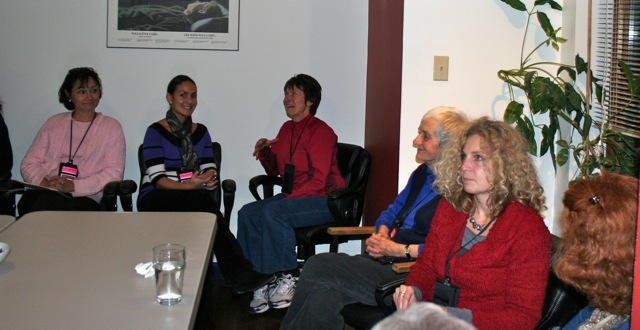
Some residents, spouses of residents, and me, had such a grand time.
PCCC has two cats.
This one sat on my bag!

Friday, 26 November 2010

Treating women with dignity

I was appalled to read this Editorial title:
'Little old ladies are crashing the system' MARGARET WENTE
First they blamed women for being raped, now they blame our precious elderly women for being ill, frail, or blame their caregivers for placing them in hospital. I have a pretty low opinion of Ms. Wente, perhaps it was her editor? I hope so.

Why do we blame the women, do you suppose? We know that senior women are the most impoverished. Many of our homemaker grandmothers and mothers were stay-at-home moms. They don't have pensions. My generation is juggling children and failing parents. I gave up a phenomenal teaching job, with a new, gem of a principal, and a classroom community of precious gr. 8s, to care for my parents.

Where does the blame lie? The lack of beds, the unpreparedness for physicians, with little time, many chronic care patients, with complicated comorbidities. But the media blame the women.


  • We don't blame the many nurses, who monitor CADDs to ensure that our palliative patients are not in pain. The medical community, it has been said, has a 17 - 20% shortage of nurses.
  • We don't blame the physicians, who march into a hospital room and declare, "She just won't die!" and provide less than helpful homecare or palliative care. Or the shortage of geriatricians in this country.
  • Don't blame taxpayers who, like the Americans, want to be able to pay for private insurance plans, but not pay for other's healthcare: those in poverty, between jobs, or the working poor. Insurance companies who can deny their American members at the drop of a hat.

I am shocked at the tone of this article and some comments. We blame adult children (primarily women, daughters, daughters-in-law) who cannot cope with an ill senior. Hospitals who send them home, telling the daughter to provide care for mother, father, mother-in-law, father-in-law who all had surgeries.

My late father, 2007, with one of his favourite PSWs
We cannot blame the system, we can blame the women for being ill, not the shortage in trained Personal Support Workers (PSWs) who are undertrained, inadequately trained, not regulated, nor monitored by any agency. We do not blame the government for the lack of foresight in naming Aging at Home as a priority, but not providing further funding. nor do they rely on much but for-profit agencies. Long-term Care homes who reheat 'retherm' meals, which are awful, do not provide fresh fruit, yet send dividends to shareholders. Something like 5/6 of LTC homes are for-profit. Is this right?

The good news is that many nurses, working and retired, are spearheading projects, like Hospices, and supporting an organized system of caring for these frail, at-risk elders in our community. Most want to be home. Most want highly trained medical personnel to help them in their homes, or in residences, not institutions.


Look around your community. You'll see many seniors volunteering and keeping their hands, brains, and bodies busy. Knitting for others. Creating quilts for raffles, or family and friends.


Wednesday, 27 October 2010

Volunteers make the world go around

I have lauded those in Muskoka who continue to work hard on behalf of others. Moving closer to Ottawa, I see our citizens who perform these acts in many venues:
    I've been working on the blog for the Habitat for Humanity build site in Bala. It is called the Patty Parsons Project. Read the blog for more information! The semi-detached homes are almost ready, they began in May.

    I have seen their motto "a hand up, not a hand out". Sometimes many hands are necessary to make a project move forward. The planning, preparing, thinking it all out.


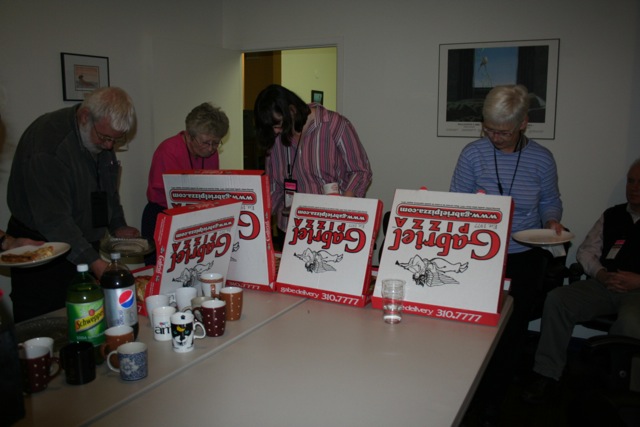
    After stuffing for 3 hrs. we stuffed ourselves

    I was happy to help prepare badges and stuff bags for the Canadian Hospice Palliative Care Association Conference in Ottawa this week. Many hands make light work. Most of you know my mother died of cancer, and my father, a brain tumour. This journey is the topic of my book, and Hospice is the focal point of my volunteer work.
    Stuffing bags for conference attendees


    Linda Truglia, in black T, giving us training!
    Last year the Conference was in Winnipeg, a bit far for me, as a volunteer, to travel.Especially since I loathe leaving my family behind.

    After, good conversation with all!
    This year, I will be helping by moderating an interest group session (Long-Term Care), as well as being a room moderator on one afternoon for three sessions. It makes for an joyful time, with a generous spirit of contribution, allowing me to attend sessions in which I am interested.

    Why do these people volunteer? At a conference such as this, there are opportunities for networking. Some are regular Hospice or Palliative Care hospital volunteers.

    Others are looking for work, and to put this opportunity on a resume shows that you are hard-working, and dedicated. You can develop contacts who will give you advice.

    Also, to attend a conference, you can learn a lot about a topic, with front line workers, physicians, nurses, clinicians, and other volunteers who use their time to work well with others! 

    I found that volunteering at educational conferences kept me cutting edge, and up-to-date on current developments.

    At the end of my 'career', if you can call it that, there was much reward in accepting student teachers, mentoring new teachers, and delivering workshops to peers and parents of school-age students. I was just interviewed by a young lady who is writing an article on seniors using technology and social media. This gave me some perspective in that my years in the field have not gone unnoticed.

    BTW
    All dressed up for shopping,
    waiting in the bum chair
    for mommy and Gamma to get dressed.
    Many men and women my age are using the Internet for good, for fun, and to connect with peers, family and friends. That is the premise of her article, methinks!

    The Internet is, of course, how I heard about this conference. Young people do not realize how involved we were. My mother learned to use a computer at the ripe age of 50, at work, to create office newsletters  in 1975. I was so proud of her! She carried on a long tradition of volunteering in Toronto and Muskoka. I am glad to follow in her footsteps.

    I learned to use computers and piloted the computer-generated report cards a Carleton Board teacher invented in 1991. Time flies!
    Gamma, did you have to bring the camera?
    Where's my lunch?
    You make think me totally altruistic, but after finishing about 8:30 p.m. downtown, I was able to sleep over
    at the kid's house, and visit with them the next morning.
    A shop-till-you-drop at the mall, and lunch out with the 'girls', Caitlin and Isabelle (7 mos.!) was a nice treat.

    Thursday, 22 April 2010

    Volunteerism in Ontario


    I am interested in the debate on *The Current of the demands the Ministry of Education makes on our high school students. They must 'volunteer' for 40 hours before they can graduate. [Policy/Program Memorandum No. 124a]

    This is unfair for many kids: those who participate in high level sports, who have part-time jobs, those who have other priorities in their lives. This notion of volunteerism has spread to many sectors.Yet, the philosophy of the provincial government, is that many Transfer Payment Agencies, and other groups can only spend taxpayer dollars with volunteers who serve on Board of Directors.

    I was in a meeting the other day. I am on the Board of Directors for FYCSM, and I am the Resource Committee chair. I also volunteer with Hospice Muskoka, I have one client I meet with weekly. I volunteer with Elke doing her Expressive Arts Therapy Bereavement classes for children. I teach creative writing at Beaver Creek. I blog about this.

    During this meeting our ED was explaining that there are issues around training for Board members, especially those who work with Transfer Payment Agencies, like FYCSM. They are creating training opportunities, e.g., two-day events, and expecting Board members to attend with no compensation to them, their employers, and for those who are employed they must take a personal leave day from work, or make other arrangements.

    You can imagine my anger with this expectation. I have served on enough Boards, been on a number of Boards, worked with Robert's Rules, and my time in precious to me.

    What an insult to us as Board members.

    The message from the Ministry is that Board members are not doing a good enough job, and we need training. Other EDs tell us that they simply ensure that they put retirees (like myself) in important positions in order for them to attend such propaganda meetings without cost to the Board or the TPA, or an employer. It is my belief that being on a Board of Directors one is elected, and is accountable. TPAs  and EDs should not be formulating Board representation, it is the Board as a whole and the electoral process that ensures we represent taxpayers. I am furious.
    ~~~~~~~~~~
    *Compulsory Volunteering - If you force someone to volunteer, does it defeat the purpose? This is National Volunteer Week. And a large percentage of high school students have to do a certain amount of volunteer work before they can graduate. We look at how well that's working out.

    Wednesday, 13 January 2010

    Beaver Creek Penitentiary

    What was he thinking?

    Beaver Creek is a minimum security prison in Muskoka, with a medium security prison nearby (Fenbrook).
    I had 12 men signed up for my Creative Writing course, here is the Follow-up Report to session #1. There was one couldn't make it.

    He skipped out, gone AWOL: someone who had earned rights and privileges and had earned the trust of Correctional Services Canada(CSC)  staff fled in a CSC vehicle, only to be recaptured. The peculiar part of the story, as reported in the paper, is that the vehicle that was stolen was equipped with OnStar, who claim to have helped capture 1000s of stolen cars.

    January 13, 2010 - by Allyson Snelling
    A Beaver Creek inmate serving time for attempted murder, arson and aggravated assault has been re-apprehended by police

    It was easily tracked and the vehicle ended up crashing into another. He worked, so the newspaper reported, in the garage, and had passed screenings. He was eligible for day parole in 2006 and full parole in 2007.

    Full story from the OPP on-line Crime Alerts news:
    Also, CTV News has video footage, plus aerial footage. 
    Plus, Rob Tripp reports on all things crime, calls him 'a savage domestic abuser who appears to aspire to kill women, Cancrime research shows.'
    Sargant Ed Medved, Muskoka OPP 
     – – 

    OPP APPREHEND Beaver Creek Escapee
    (BRACEBRIDGE, ON.) – Members of the Ontario Provincial Police (OPP) Bracebridge Detachment were advised that a male inmate had escaped from Correction Services Canada (CSC) Beaver Creek Facility at approximately 9 o’clock Tuesday morning, Jan. 12.

    57 year old Robert John SAUNDERS, was suspected of driving away from the facility in a stolen (CSC) vehicle.  SAUNDERS was located and apprehended by members of the Toronto Detachment OPP in the hwy 401/403 following a pursuit of the vehicle.

    Robert John SAUNDERS is now in custody, a joint investigation into the incident is ongoing through both the OPP and Correction Service Canada (CSC).
    ~~~~~~~~

    Beaver Creek Institution

    Beaver Creek Institution is a minimum security institution located within Gravenhurst, Ontario, on a federal reserve along with Fenbrook Institution. Beaver Creek opened in 1961 and can house up to 202 inmates. Inmates are housed in five residential style units.

    Constable Maureen Tilson - Muskoka OPP
    The Institution provides correctional programs that promote inmates’ successful reintegration by allowing them to live independently and giving them responsibility for their needs. Inmates live in an environment with standards as similar as possible in a correctional setting to those in the community (i.e., preparing meals in small groups, being in charge of cleaning the units, etc.).

    There are 235 employees at Beaver Creek. In addition, the Chaplaincy Program helps the Correctional Service of Canada to meet national and international commitments with respect to the promotion of religious rights and obligations of offenders.

    Many volunteers help by involving inmates with Bible Study, presenting seasonal choral performances, support meetings. Volunteers contribute across the nation through CSC, to a variety of institution-based programs including chaplaincy, recreation activities, classroom and workshop instruction, social events and cultural activities.

    CHIRP. This is a program by which offenders record a bedtime story onto a CD for their children, the CD then being sent home for the child to listen to at night.


    ~~~~~~~~
    Correctional Services Canada


    With a wide range of services...

    In 2003 the Canadian Families and Corrections Network (CFCN) received a Contribution from the Correctional Service of Canada for a two-year demonstration project at Millhaven Assessment Unit (MAU) in the Ontario Region.

    As a result of this initiative:
    • CFCN sent Time Together: A survival guide for families and friends visiting in Canadian federal prisons to partners and intimates
    • all new offenders participated in a session on families, corrections and restorative justice
    • Discussions of how criminal behaviour harms families
    • Two videos were used as a part of the orientation process. "Making Links to the Community" describes the role of the voluntary sector with offenders
    • "Prisoner Families: Facing the Challenge" focuses specifically on the unique needs of families affected by incarceration.
    • One Day at a Time: Writings on Facing the Incarceration of a Friend or Family Member was sent to parents and other family members.
    Correctional Service of Canada (CSC) has been implementing its Transformation Agenda. Quick Wins, a Transformation Initiative, is starting to produce concrete results in such areas as safety and security; correctional assessment and program interventions; mental health; community corrections; and victim services.
    • An electronic monitoring pilot in the Ontario region; development of a new integrated correctional program model that allows offenders to access programs earlier in their sentences; and successful community events and symposia on key transformation themes, including improving mental health services for offenders, Aboriginal employment, education and managing gangs and drugs in institutions.
    Quick Wins in Safety and Security
    • Increased the number of detector dog teams: five were in place by December 2008 and five more teams are scheduled to be in place by April 2009.
    • Held a national Security Intelligence Officer competition to further strengthen and enhance CSC intelligence capacity within the institutions and in the community.
    • Replaced x-ray machines and ion scanners in several institutions and introduced, and will be testing, new equipment.
    • Held a symposium on managing gangs and drugs in institutions in Ottawa (December 2008).
    • Implemented scheduled visits for all institutions (June 2008).
    • Developed a national visitors' database to monitor and track visitors (June 2008). 

    Literature Review On the Factors Related to Escape From Correctional Institutions

     A Literature Review - mostly North American, and US studies

    Property Offenses – more likely to have had property offences

    Prior Institutional Escapes – 3 times more likely to have escaped from a juvenile institution, escape record is a good predictor of escapes, bringing to bear risk assessment
    Race – escapes tend to be predominantly white, 1 1/2 times more likely to escape, despite blacks being
    Age – escapees tend to be younger, NY study: 79% < 30 years, a Canadian study (Correctinoal Service of Canada, 1989) states that as offenders age they slowly desist from criminal involvement.
    Prior Confinements – history of juvenile confinement
    Sentence Served – 50% in one study had served <1 year, served less than half of their sentence,, perhaps 3 to 4 months.
    Other Factors – marital status, juvenile criminal history, education, length of sentence, number of dependents, prior parole and probation violations, family issues (divorce, separation, illness or death in the family), relationship dysfunction, lack of contact with family members, poor family ties, 'dear john' letters, distance away from home, alcohol and drug addiction, parole denial, institutional crisis situations, misconduct, outstanding criminal charges, lack of institutional rehabilitation programs. 
    Escapes tend to occur in warmer spring and summer seasons and weekends. 
    Unemployment, 45% didn't have jobs at the time of their arrest. 
    Transfer from minimum security to maximun is a predictor of likelihood of escape.