Sunday, 28 September 2014
We had visitors!
Eastern Ribbon Snake from Jennifer Jilks on Vimeo.
Dorah brought me an Eastern Ribbon Snake. I picked it up and took it inside. Jos was eager to hold the snake. The kids were visiting and Jos held it for awhile. What a great experience!


Forest walkies with grampa
Grampa walkies from Jennifer Jilks on Vimeo.
Grampa and Isabelle did walkies, Sadie went, too. Isabelle led the way, marching along tough cookie she is, until Grampa suggested he could lad and get rid of the spider webs for her. They went down to the point, around the meadow and down to the frog pond, where she played with a stick in the water. She chatted the whole way, as is her way, about grass, leaves, moss, leaves, paths, mushrooms, and all the things they spotted along the way.
Tick count 2014 and Lyme Disease
 |
| Swollen tick, engorged with blood, taped to a piece of paper! |
How to remove a tick from a pet
I used the handy pointy tweezers, you can see the photo of them below.
The tick counts for 2014 have totaled 52 this year. Compare this to the 89 we counted last year. This is a good thing. We had a long, cold winter and I hope it killed some of them off. I have no idea what kind of ticks they are, we just assume that they need to be removed. |
| Pointy tweezers, 2 ticks. One engorged, the other not. |
Climate Change has had an impact on this disease. They are able to survive our cold climate as it is warming up.
In 2005 researcher Nicholas Ogden wrote that the geographic range of the Lyme-carrying tick could expand northward due to climate change in this century.
Ixodes scapularis, the blacklegged tick, is the main vector in eastern and central North America and I. pacificus, the western blacklegged tick, is the main vector in the west. Both tick species are
 |
| About half this year, after a long, hard winter. |
There has been some ignorance, mostly on the part of physicians, who have denied the symptoms of Lyme Disease. This year, the health agencies have been celebrating a lower rate of infection, but this is simply the result of fewer ticks, I believe. It will be easy for their numbers to bounce back in a less severe winter.
The Green Party has demanded a National Lyme Disease Strategy, Lyme borreliosis. This is laudable, but I'm not sure it will make a difference. Each province and territory has its own healthcare system, with transfer payments and Canada's Public Health Agency having a hard time whipping some provinces into shape.
For years, in our region of southeastern Ontario, physicians have ignored the symptoms of Lyme Disease, and have attributed them to others diseases like Lupus or Fibromyalgia. This has changed as those who work outdoors have succumbed to Lyme Disease. Climate change is just one of the factors, since both tick species are able to complete their life cycles in our short summers. Habitat suitability, host abundance and dispersal by hosts, are the other three factors.
Symptoms
For the most part, it is the physicians who must be aware of the symptoms. |
| Old Lyme, Connecticut |

Here is the tick I pulled off of Daisy the other day. It was on her neck, fully engorged.


 |
| Total 89 ticks in 2013 |

But officials told her not to worry, Lloyd said. Lyme disease was exceedingly rare in the forested maritime province northeast of Maine. The tick was tossed untested. The next year brought agony: Fatigue, fevers that would come and go, aching joints, and finally, trouble lifting her arms or walking.
 |
| Figure 2. Ixodes scapularis ticks collected in passive surveillance in eastern Canada |
The Rising Challenge of Lyme Borreliosis in Canada (2008 report)
 |
| 2008 data |
Saturday, 27 September 2014
♪♫ ♬ Shall we gather at the river?
 Yes, the gosling have grown. From eating grass beside the rivers, they are flying further afield!
Now they fly off with the flock to load up in the fields.
These are on Port Elmsley road, in the field.
Hunting season has begun. The cats were afraid to go outdoors with all the shooting in the distance. It's that season again.
From where the sounds are coming from, I think they are trespassing! I cannot imagine Ian Millar's horses are happy, either. I think it is duck hunting season, but I'm not sure!


These are from my archives, when we lived beside the lake.
 |
| SC #43 |


Friday, 26 September 2014
Cat walkies around the frog pond
Across Oliver's Lot, through the grasses. I could hear Buster yowling off on the grass, as he was slow to follow, and didn't like being left behind. Daisy often runs to be ahead. Then they lie down in some foliage and jump on each other's heads in surprise. Buster chased Daisy up a tree.
He used to have such fun with his brother. Thankfully, the girls have kept him kittenish. He was so sad when we took walks after Felix was killed.
The sun is very low, as it was later in the day. I love the changing light levels, as the fall Equinox has arrived. It illuminates different parts of the forest.


Eventually the old boy caught up to us girls. No sign of the muskrats, although I did read they are somewhat nocturnal, I have seen plenty in the daytime. They've built a 2nd shelter, in the right of the next photo.


Around the frog pond, they had a bit of fun.


Back up the hill, at the house, Dorah was playing with her mice friend. Buster was mildly interested, and Daisy got right in there. It got away. They are amazing the way they stand up to the cats. Dorah used to get bitten on her nose, she's smarter now.


He used to have such fun with his brother. Thankfully, the girls have kept him kittenish. He was so sad when we took walks after Felix was killed.
The sun is very low, as it was later in the day. I love the changing light levels, as the fall Equinox has arrived. It illuminates different parts of the forest.


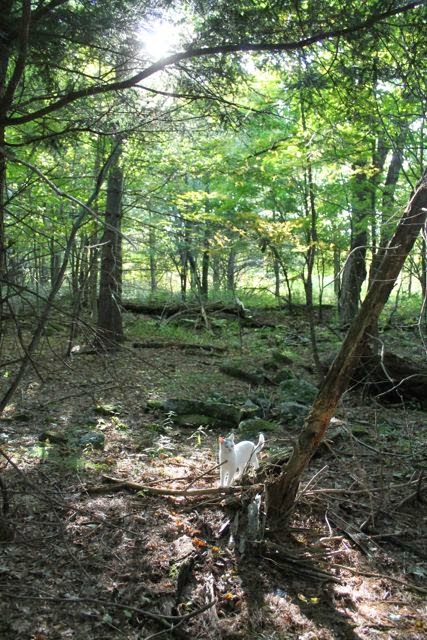


Eventually the old boy caught up to us girls. No sign of the muskrats, although I did read they are somewhat nocturnal, I have seen plenty in the daytime. They've built a 2nd shelter, in the right of the next photo.


Around the frog pond, they had a bit of fun.


Back up the hill, at the house, Dorah was playing with her mice friend. Buster was mildly interested, and Daisy got right in there. It got away. They are amazing the way they stand up to the cats. Dorah used to get bitten on her nose, she's smarter now.
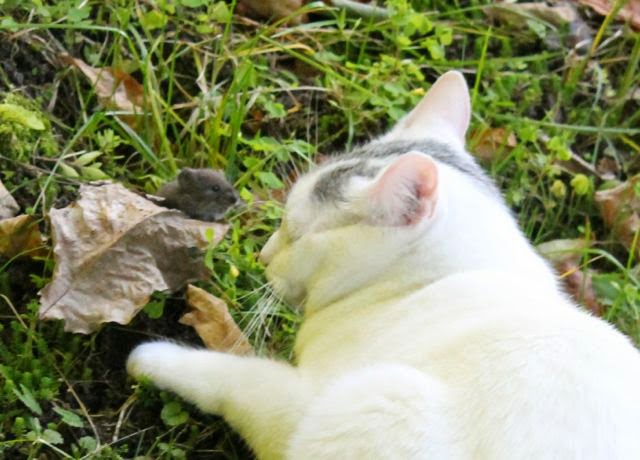 |
| It looks like its speaking sternly to her! |


Cat walkies video: a race up the hill
When we come home from city appointments it's nice to take a walk in the forest.
Cat race from Jennifer Jilks on Vimeo.
'TWAS a race up the hill from the meadow. The 3 cats like to compete and see who gets up first.
Cat race from Jennifer Jilks on Vimeo.
'TWAS a race up the hill from the meadow. The 3 cats like to compete and see who gets up first.
Thursday, 25 September 2014


Subscribe to:
Posts (Atom)