Showing posts with label biodiversity. Show all posts

Tuesday, 13 August 2019

Climate Change and Lawns

The NY Times had an interesting video documentary on lawns. The old photos are amazing. It was 7 minutes long, and I do not normally watch 'newspaper' videos, but this was more documentary. 

The Great American Lawn: How the Dream Was Manufactured

Coincidentally, I've been thinking about lawns. We've had some drought, again, and it does require that we manage our lawns differently.  We've since had some rain, but we have to be careful. There are many, I find, who shave their lawns closely, not giving it a chance to absorb even morning dew.

My house on Hobart had a small lawn, and I was trying to change it over to plants. To the left of the patio stones I'd replaced grass with plants. Then, we moved to Pine Glen, and then Muskoka! (This is the beautiful birdbath that was stolen from us.)


It's an excellent piece the NY Times video. During white colonial settlement, forests were felled, farmland created. The settlers cows and sheep ate the indigenous grasses that existed. In these days of Climate Change, with both flooding and drought, our thoughts must change. People are using too many chemicals to keep lawns pristeen, as well.

In the video, you can see how rich Americans began creating large lawns on large properties. They imported the romantic English and French notions of parks, as well as 'Kentucky Blue Grass' (actually a native species from Europe), in areas where biodiversity thrived. Technology changed things, as is its way. They highlight the development of cities with water systems, which meant the individuals could water more frequently and maintain a lawn. The development of lawn mowers, which meant maintenance was easier, meant that plantation owners could play lawn bowling on manicured lawns, maintained by slaves.

There are many books on lawn care, as well as hundreds of magazine articles! We've moved into a new era, however. With guerilla gardening, and rooftop gardens, etc. we know the value of looking at lawns differently.

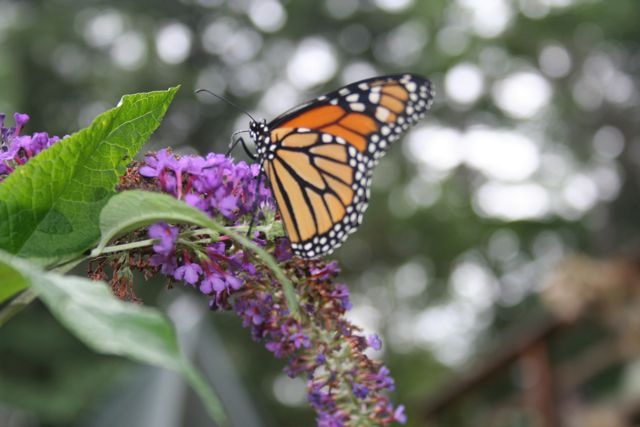
I've been leaving our front lawn alone in spots. The wild oregano has taken over, which hosts all sorts of critters!
monarch on wild oregano from Jennifer Jilks on Vimeo.

What people are promoting is a laissez faire attitudes. I am up for that. Now, the bugs do hide in the grasses, but it doesn't truly keep the bugs away to trim a lawn to 3". I've let the weeds grow.


This is Oliver's Lot. They kept it cut, previous owners. I've let it go and the sumac has come back, as well as the milkweeds.


In spring, I love the dandelions and wildflowers.

These are two trees I transplanted, one a spruce and the other a serviceberry.


Aside from flowers for insects, milkweed for monarchs, the reptiles and amphibians love it, as well. We have leopard frogs sitting in the lawn, eating bugs. I spotted a ribbon snake, as well.


I bet it is difficult to see it in the above photo. The clover provides sanctuary.  Photo fail, archival photos show the ribbon snake much better!


You can see in the backyard how lush the grass can be, but with climate change, it's been too dry.

 In the backyard, I create a path. The ticks like the long grasses, so a path is a good way to do this.
I've let the pumpkins have their way in the backyard. Coincidentally, I found a milkweed tussock moth, which I'd not seen before! I shall have to revise my life cycle!

I'll bet people have a hard time with this. People seem to cultivate the pristeen, manicured lawns.  Perhaps it is time for change!

Monday, 23 April 2012

Biodiversity, sharing the earth, and species at risk

Murphy's Point Park
Here I am in the summer

I went to the Friends of Murphy's Point Park AGM Sunday, April 22nd, Earth Day. How fitting! 

After the business part of the meeting,
Tim Wood, who used to work in our park, gave a lively speech on Species At Risk.


She looked a bit worried!
I went back to try get a better photo
Now, I've been teaching about biodiversity, ecosystems, and respect for the environment for many years. Many of my blog friends feel the same about the environment and biodiversity as I, and are amateur naturalists.

Tim spoke of the great movement of the 1990s, when we realized we were killing animals off on this planet, but I have been lecturing students about these topics, and creating curriculum activities around this topic for all of my 25 teaching years. I am glad that this tradition continues.
Tim Wood
Common Ground
Sharing the Earth with species at risk
by Tim Wood, who now works for the Leeds-Grenville Stewardship Council

Globally, up to 40% of all living organisms are at risk. Since Europeans arrived in Canada over 30 species have become extinct in Canada. Over 600 species are at-risk, in Canada. About 200 in Ontario are at-risk. Unfortunately, living in Lanark County's 'Back off government' and Muskoka's landowner's association's mindset, Ontario's Biodiversity Strategy is crucial for the survival and biodiversity of many species.
WHYARE THEY AT RISK?

Habitat loss
Wetlands were thought to be useless, but they absorb frost, get us through drought, and clean up water systems. In Ontario, 90% or our original forests were cut for agriculture. Clear cutting of the day. Ghosts from the Day - Part 2 A royal commission in 1898 found that Georgian Bay fishermen were using undersized nets, and exceeding the number of permitted nets. They estimated that more than 2000 nest were strung in the Bay. This combined with effluent pollution by lumber barons created ghost towns...
No trees meant dust bowls, which blew soil away. The canopy is so important to critters like flying squirrels.
Dodging deer and moose in N. Ontario
Pollution – for example, the General Motors foundry EPA clean-up in 1990. Stone studied a snapping turtle in Akwesasne, which they analysed 1987. Its fatty tissue was 3067 parts per million of PCBs. This is 60 times worse than toxic waste. They found a masked shrew, with 11,522 PPM, and couldn't imagine how it could survive.
Land Use change, fragmentation of habitat. Highways, dividing landscape, e.g., 401, is a horrible way to treat our critters. Thank goodness some places are improving roads. Clear cutting.
Alien, invasive species – Brockville is the ground zero for invasive species. Emerald ash borer. Zebra mussels (3 billion/year); wrong nutrients for predators; lamprey, 40kg of native fish; Asian Carp (voracious eaters); purple loosestrife; giant hog weed.
Persecution: There is much misinformation about critters like: snappers, wolves or snakes. Citiots go to the country and kill snakes. Many fear snakes for no good reason. In cottage country, they did not understand, much like the bison.
poor snapper
Road mortality. One study of a 40-km section, over 80 days in E. Ontario, they found roadkill of 6000 animals. Turtles, snakes, porcupine, frogs: wet humid evenings seeking different habitat, birds of prey, red-tailed hawk. On our stretch of 500m we have had two porcupines killed this past week. In summer we were averaging 2 or 3 a week. Deer collisions are high in Mississippi Mills. Safe driving guidelines.

Contributing factors – inherent: monarch needs milkweed (listed as noxious weed) and farmers are clear-cutting side roads. Piping plover: habitat needs sand. Snapping turtle age of reproduction: 17 years, perhaps age 20? Tim thought that 1/1400 snapper eggs make it to sexual reproductive age.


Sliding scale of species who are in danger of extinction, evaluating species at risk
salamanders predict danger in an ecosystem,
they are sensitive to pollution
blue-spotted salamander
  1. Species at risk -
  2. Special concern - 
  3. Threatened - 
  4. Endangered -
  5. Extirpated - gone in a particular region or ecosystem.
  6. Extinct - gone forever.

1. Species at risk

TURTLES:
In Ontario we have 8 species of turtles, of those 7 are at risk: 
Northern Map turtle, Blandings, Snapping Turtles, stinkpot turtles.
This was the mother of all turtles, spotted July, 2009, on Long Lake, Bala, Muskoka.


green tree frog
usually sleeps in our mailbox
2. Species of special concern: the bald eagle (they steal food from osprey, as they are larger). Eastern wolf; extirpated in Ontario. It is the Big Bad Wolf syndrome: farmers thought threats to livestock, and there was a bounty for pelts. Currently, it is the coyote who is being persecuted in cities. They will be next. Many loathe reptiles and amphibians, for some reason.

3. Threatened: Blandings turtle, lake sturgeon (fishing, roe), massassagua rattlensnake.  
Massassagua rattlers in Georgian Bay – I'll never forget the blasting when they put in new highway 11 roads back in the day. The rattlers were on the move in our forests all summer. All of our neighbours were on the lookout for them, and killed them on sight. Loss of habitat and clearcutting destroyed Native lifestyles, as well as animal. Silt flooded fish breeding grounds and destroyed the economy. Also threatened, due to persecution; gray ratsnake.
massassagua rattlesnake,
dead as a door nail

4. Endangered: barred owls (s. Ontario; their song 'who cooks for you'), spotted turtle, Jefferson salamander.

5. Extirpated: tiger salamander, timber rattlesnake, greater prairie chicken, paddlefish.

6. Extinct: passenger pigeon, 1914 last one died, low millions, 250,000 birds sent in 3 days.  

What do we do?
Sadie, our cat, treed this guy in 2009
Protect habitat; education; awareness; watch the road; monitoring and reporting at risk species; monitor pet stores; protect nesting sites and critical areas; stewardship: turtle basking racks, bald eagle nesting sites, Leeds-Grenville: nesting boxes for snakes; reintroductions can be iffy: loggerhead shrike; trumpeter swan: marsh S. Ontario (Charleston Lake); fishers reintroduced in Ontario

Tim made an excellent point. We know role of a particular species in an ecosystem until they are gone. For example, eastern wolves in Yellowstone Park. Once they were extirpated the elk and coyote populations were out of control. Invasive plant species went wild, and increased their invasion, too. 

flying squirrel in Muskoka


Success stories: reintroduction of beaver, Canadian geese, peregrine falcon, flying squirrel, bluebirds, eagle.


Gray ratsnake - a constrictor,
she lives at the park


Friends of Murphy's Point Park Annual General Meeting
President, Stephanie Gray; park Sup't, Curtis Thompson;
senior park naturalist, Tobi Kiesewalter

Mike Murphy has a FB page!

Even the press was there!


Chili cook-off. I had to miss it,
hubby needed the car!

Wednesday, 29 February 2012

Ontario Biodiversity Strategy


Variety is the spice of life!
Imagine what life would be like without a blue-eyed, blond or red-headed granddaughters!

How sad it is that I live in Lanark County, the 'back off government', libertarian capital of Ontario.

No sign of Ontario enacting biodiversity strategy: Report
The Kingston Whig-Standard
Budget cuts expected in the spring will only weaken the ability of the government to respond to environmental threats, Ontario's environment commissioner, Gord Miller warned.

Ontario has an obligation to meet the objectives of international treaties Canada has signed.
We risk our international reputation if we do not do so.
Ontario's Biodiversity Strategy, 2005, identified five major threats:
pollution, climate change, habitat change or loss, invasive species and unsustainable use of resources.

Biodiversity of species
The cycle of life depends upon the predator/prey cycle. If one part of the circle dies out, others become too prevalent, harming other species.

Biodiversity of ecosystems
Ontario has a wide variety of systems: tundra, wetland, woodlands, prairie. Our slash and burn development harm many. Coyotes are now a problem in cities.

Biodiversity of genetics
Genetics means variations within species. Imagine if we lost the red fox or grey fox.
The big factor is loss of habitat, but other factors include legal and illegal hunting, humans encroaching in areas where these animals live, eat and breed.

Endangered or at-risk
For example...
Snapping Turtles
Massassagua rattlers in Georgian Bay – I'll never forget the blasting when they put in new highway 11 roads. The rattlers were on the move in our forests. Loss of habitat and clearcutting destroyed Native lifestyles. Silt flooded fish breeding grounds. Criminal.

Milling in Georgian Bay peaked by the decade of 1910, rivalling that of Ottawa, something Sir John A McDonald complained about. . Shaped by the West Wind quotes James Angus,  writing about A.G.P. Dodge, the owner of the Georgian Bay Lumber Company:

~~~~~~~~~~~
Invasive species
Purple Loosestrife

There are several species who are beginning to invade Canada from parts afar.
  • Water soldiers
  • Zebra mussel
  • Sea lamprey
  • Round goby
  • Purple Loosestrife
  • Spiny Water Flea in the Great Lakes Region - competes with fish for food
  • Giant Hogweed
    Bala, Muskoka
  • Giant hogweed.

ImageOntario Biodiversity Strategy

Interim Report on Ontario's Biodivesity

In May 2008, the Ontario Biodiversity Council released the Interim Report on Ontario's Biodiversity. This interim report is an important milestone towards reporting on the state of Ontario's biodiversity in 2010. The interim report is not a comprehensive report, but instead is a gathering of information from existing sources, presented in plain language and illustrated with focus stories. The goal of the interim report is to initiate the process leading to the 2010 report. The interim report contains background information on Ontario's biodiversity, a discussion of threats to biodiversity and a description of some of the efforts underway across Ontario to conserve biodiversity. Download a copy.


Image

Ontario's Biodiversity Poster

To download a copy of a poster developed by the Ontario Biodiversity Council and the Ontario Ministry of Natural Resources, please click here.