Sunday, 4 August 2013

Glengarry Highland Games –sheep dogs, police, bands, heavyweight competitions!

Good, clean fun! Nicely dressed young people, primping and preening. Kilts of all colours. Competitions and highly skilled, well-dressed people, all. Fiddling, dancing, piping and throwing of heavy things!
Men and women in blue, making sure all was well. They fit in rather well, in uniform!

Hardly a tattoo in the bunch, except for the pipers piping. There were very few people smoking, too.
The Glengarry Highland Games in Maxville: lots of pomp and circumstance.

18th Century Musket Review & Quigley Highlanders Pipes & Drums


Sheep Dog Demonstration-Werner Reitboeck- Navall Farm


Masters Heavyweight Competition 

–both men and women chucking these canonballs!

UK CARS!

Saturday, 3 August 2013

Maxville's Glengarry Highland Games –sights and sounds


Quigley Highlanders Pipe and Drums  from Jennifer Jilks on Vimeo.
What fun at the Glengarry Highland Games.
The Quigley Highlanders Pipes and Drums group is fabulous. Spit and polish.

18th Century Musket Review


18th Century Musket Review from Jennifer Jilks on Vimeo.
Fabulous kilts and uniforms at the Glengarry highland games

Sheep Dog Demonstration-Werner Reitboeck- Navall Farm

 
Sheepdog herding sheep from Jennifer Jilks on Vimeo.
Sheep Dog Demonstration –Werner Reitboeck- Navall Farm. He began with his older, experienced 'retired' dog. Then showed how much training can do and how the younger, 4-year-old dog, had herding instincts. It was amazing how the dogs sit, watching his face, total adoration, just waiting to get going.

  1. Border Collie FAQ> - Navall Farm Border Collies

    www.workingbordercollies.ca/BorderCollieFAQ.htm‎
    Feb 3, 2012 - If you have any specific question ...and I shall do my best to ... I personally would only buy a border collie from a working home - sheepdog trialling (ISDS style) or farm work. ... Werner Reitboeck,

Throwing heavy things around!

 
Throwing from Jennifer Jilks on Vimeo.

Bee careful out there!

You can see my lovely drooping flowers!
They cover the path around the pond.
 I had a plan Thursday. I thought I should tie up the Phlox and the Brown-eyed susans that were drooping and touching the ground.

Tall plants look better standing up like soldiers in the garden!

I was using stakes and tying twine around them. It was difficult getting to the roses to dead head them, the Susans were nodding their wet chins on the ground, the moths couldn't get to the phlox, with the 34.5 mm of rain that day.

 Weeding around the pond was a trial. As hubby says, most of my 'gardening' involves taking out plants that should not be there!
I thought the plants looked better standing up!
I had a mission and a plan.

I was about to get to the last phlox in the front, the bright fuscia-coloured ones had just begun blooming. I have been having fun taking photos and making videos of the nocturnal sphinx moths on the phlox.
Incoming!
I didn't quite get finished.
I was stung by a honey bee. Are they ever painful! Right through my pant leg. I looked down about to smuck what I thought was the ubiquitous deerfly, and swatted the bee away.

In hindsight, it was a forewarning. Once I had stood the plants up, and the bee had stung me, I noticed yellow jackets swarming in and out and about. There is a nest, likely in the field mouse tunnels under the garden. The same mice that have chewed holes in the goldfish pond liner.

Three days later, I still have a 3" rash, hot and swollen, from the wee bee. The yellow jackets are still coming and going. I guess this part of the garden won't be weeded, except in the dark, when they sleep.

The honey bee saved me from the yellow jackets, who swarmed about for a couple of hours. I never did get a good photo of them. These are screen captures from the video.
Two hover, flying into the nest.
I was duly warned.

CC #278
Bees in my bonnet from Jennifer Jilks on Vimeo.
I was working in the garden and a honey bee stung me.
I was quit upset. Happily, moving away, I discovered a garden full of yellow jackets who began to swarm. It was a warning!

Friday, 2 August 2013

Daisy and her deer

Such an angel –not!
Here is our wee Daisy. Runt of the litter, and much smaller than her twin, Dorah. She is a trouble maker, climber of trees, chaser of deer. Both kittens will be a year old this month. We're not sure when they were born, as they are rescue kittens.

The female deer isn't sure what to make of her! She is so wee, unlike our other cats.

We only have one male, Buster left. The other 3 cats are females, less inclined to wander. We've had two male cats struck by cars in the early morning on the highway.

Daisy is sitting in the rock garden;
'Bambi' watches her carefully
There was a male cat bothering Buster in the night for a couple of weeks. It began in July, cottage season. It would come to the back door, and you could hear the territorial male cats howling at each other in the wee hours.

We began to let Buster outside in the night to fight, since he'd otherwise take it out on his siblings. This is called deferred aggression, and we had this in another male cat, Max. We realized the only thing to do is to let them fight it out. Animals usually come to an agreement, unlike humans who like to fight to the death with weapons. Animals seem to convince one another and talk their foes down, better than humans.

Anyway, the cat that had been 'visiting' Buster, hubby found dead on the highway. He moved its body into the ditch. Terribly sad way to go.
Such a busy highway it is.

Daisy and the deer from Jennifer Jilks on Vimeo.
Daisy was playing in the rock garden. Bambi came along, fascinated with her! Daisy has inner bigness. I love the bobbing head, as the deer tries to figure out if Daisy is friend or foe!

Tigger followed Oliver,
Tigger's twin was in the forest,
shadowing us all on our forest walk.
I'm not sure if my readers remember that Oliver
Tigger's first antlers,
he went back to grazing after
I moved away.
used to be followed by Tigger, a fawn we saw grow!

I loved watching Tigger. He would literally bounce about in the back yard.

We could tell him by behaviour later, as he was the only deer that would approach us without fear. Then we could tell him by his wee rack when he returned!

Oliver is gone now –smucked by a car on the highway. (Yes, granddaughter, he did NOT look both ways. Good lesson to be learned.)
Tigger, foreground, and his twin brother last winter.
Here is another deer watching Felix (Buster's late twin),
 who ignored her!
Felix was also killed on the highway.

The deer are fascinated with the cats. Oliver liked to herd them, and get them away from the bird feeder, as well as the wild turkeys. Buster does the same thing.

Tigger has grown into a nice young buck. He came back to visit in January with his brother. I spotted him with his tribe last year. He also visited with his extended family. The males do not normally hang out with the females.
They have different winter yards.

Thursday, 1 August 2013

What a spectacle in the night: Sphingidae or sphinx moths are huge

Female Io - Automeris io moths,
are as large as the sphinx!
The Io moths and Imperial moths are large, but the sphinx tends to be  the most diverse.


I've managed to photograph both the Io caterpillar and moth. A tricky job, I can tell you.
Io caterpillar
Half the battle in IDing them is knowing your ecosystem, habitat range, and the likely species you might find.
Io moth with closed wings,
fabulous eyes on the underwing


The largest I've photographed was the Imperial moth. It was resting one summer morning last year, on our cedar rail fence right beside the house. More common are the sphingidae or sphinx moths.


Feeding at night
Large, Imperial moth
Io eating my Hops plant leaves!
They feed on tubular flowers, like my phlox, with their long proboscis.
Most, the Peterson Field Guide says, are nocturnal and are drawn to the lights.

Two nights ago we managed photos of this friendly sphinx, as well as a baby gray tree frog and a firefly.

Moth identification
I use the BAMONA website, staffed by volunteers, experts who help me identify the moths and butterflies. There are so many about.

More than 11,000 moths alone, with my Peterson Field Guide to Moths of Northeastern North America IDing only 1500. It does help when you understand the difference between a Silk moth, an underwing, and a sphinx!

Trapping Moths
Lovely markings on the sphinx
There are ways to trap moths, using sugar as bait is one. They also have fancy dancy traps, with a light in the middle, and a clear funnel to safely trap them. Some people have created their own Skiner traps using a light and egg cartons as a resting substrate. Their gossamer wings are fragile, and any people I know are against harming a creature in order to trap and photograph it.

Moth bait
Some moths understand that lights are fake, and you'll need nectar to attract them.
One mixture consists of:

  • a soft banana
  • a scoop of brown sugar
  • a dollop of molasses,
  • a glug or two of beer.
Paint this on a tree, or on a thick rope strung between supports. Watch out for the raccoons, though! Check it regularly.

Photographing moths
Imperial moth body
is the diameter of my finger
They are tricky to photograph, in the dark. I often spot them while trying to get cats in at night, as they are strong fliers and zoom about like the hummingbird.

They also say to put the moth in the fridge for one night to cool it down, making it slower and easier to photograph in natural daylight. They get into a state of torpor, calms them and lowers their metabolism.

Sphinx moths
White-lined sphinx on phlox
Fascinated with critters in the dark, I could see a sphinx thrashing about in the spotlight. They love the phlox and I usually see them when they are in bloom.  The larvae of the sphinx pupate in the soil, feeding on wood or herbaceous plants.

This sphinx seemed to quite adore us!
They are quite impressive, as you can see from the photos. The Hummingbird clearwing is the smaller of this species. It is often called a hummingbird moth.

Their bodies, as my field guide says, are 'robust!' They come to a point.
Sphinx are all over the place


Narrow wings (e.g., Great ash sphinx), or some, like the Blinded sphinx, have irregular wings, almost like tatted lace. The Blinded sphinx photo below shows the pretty colour in the underwing.

Here are some of the other sphinx moths I have photographed!

Sphinx chersis
Great ash sphinx
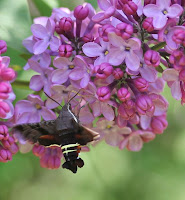
Hummingbird clearwing moth!
One of the diurnal moths
Leggo!!!!

Xylophanes tersa Tersa Sphinx
A great, long proboscis
Blinded sphinx underwing

Paonias excaecata
Blinded sphinx


Bipectinate antenna;
fuzzy wuzzy basal area!

Clearwing in spring on lilac

Baby tree frog!

I spotted a wee, baby tree frog! They call them gray tree frogs, but they can be gray or emerald green!


Wee little thing!
Life imitating art!
Click on the video to hear their song!

Nighttime firefly

Finally, there was a firefly on the window, too. I wrestled with the camera and did not manage to get a photo of it in full green lighting up!