Showing posts with label polygonia interrogationis. Show all posts

Monday, 14 August 2023

Caterpillars, deer and a wild turkey

 The goldfish pond is over flowing, for now. Lots of rain.


Aug. 10 storm from Jennifer Jilks on Vimeo.

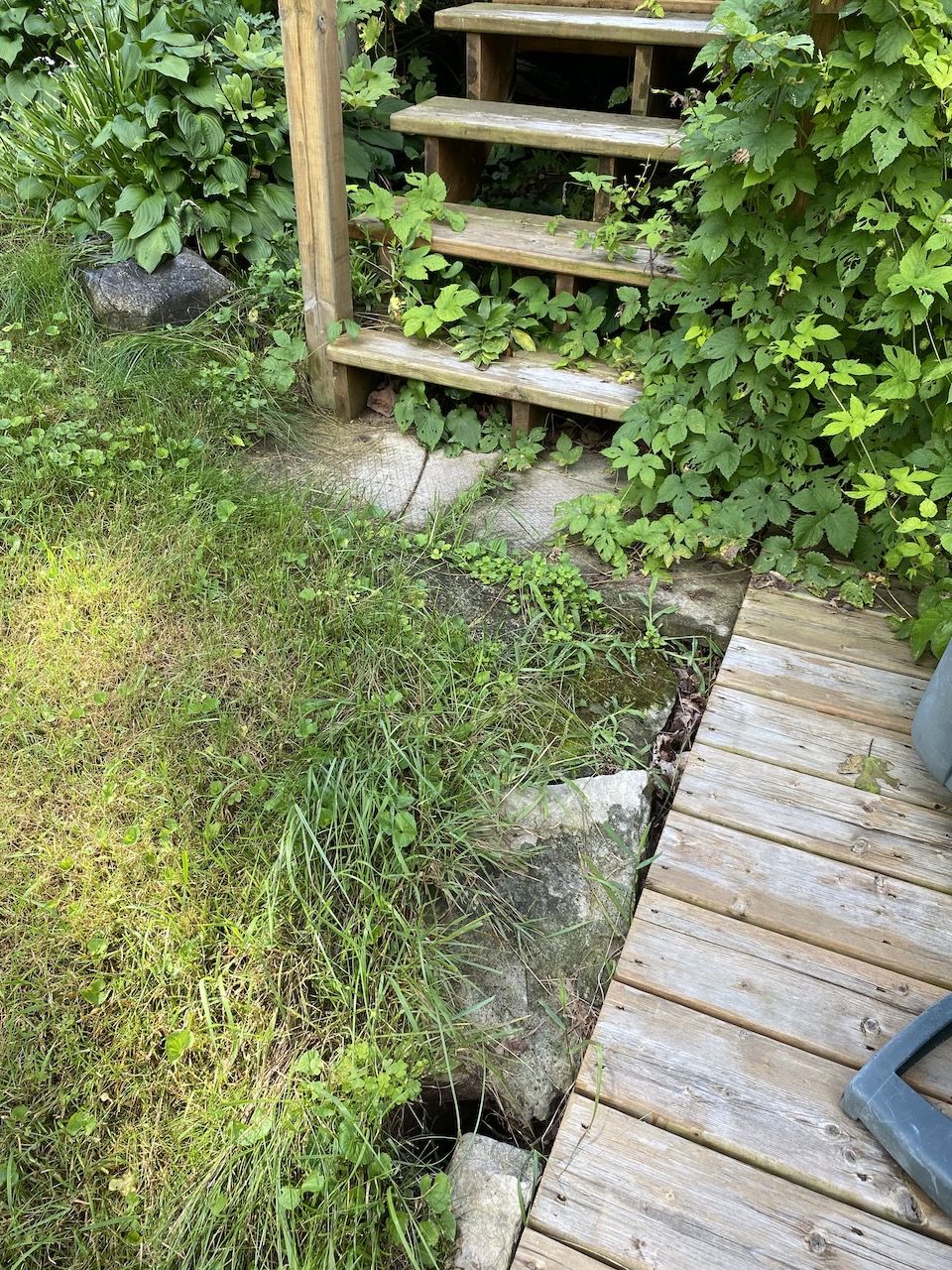
Out back, Fred has dug another tunnel exit. It's really not a good place in spring, as the meltwater pools under here. 


The caterpiglies are growing still! They are either polygonia comma, or polygonia interrogationis. 

And a different species:

I pulled out my chair to have a sit on the deck, and froggie hopped down from under the chair.  It ended up on the railing, again!

This is funny. There are all sorts of tricks to capturing critters on trailcams. If you tilt it low you capture critters like skunks, but the deer!

buck from Jennifer Jilks on Vimeo.

I was awake around 4 a.m., hearing coyotes yipping away. I got up and came back to the bedroom, outside I could see our skunk. It's a busy spot.

 I hope our young wild turkey survives!

Sunday, 26 June 2022

Birds, butterflies, Bugloss and Bambi

UPDATE: Burlington is still fighting naturalization. 

‘You want to fine them $10,000 a day?’ The City of Burlington fought this family’s natural garden — and then razed it anyway June, 2023 

 "As a penalty, the city had threatened an astonishing $10,000-a-day fine until the yard was remedied to their standards — a notice the city also sent to the Barneses’ mortgage company." 

 "Donnelly also represented landscape ecologist Nina-Marie Lister and her husband, Jeremy Guth, in 2020 when the City of Toronto said the front-yard meadow of their sprawling Wychwood-area home needed to be cut back. "

  ‘What kind of barbarian would mow buttercups?’: The city tried to rip up a local ecologist’s natural garden. Now she’s fighting back – Oct., 2020

"Nina-Marie Lister and her husband Jeremy Guth turned their lawn into a wildlife and pollinator paradise. But complaints from neighbours led them to lawyer up and ask the city to rethink its rules for gardens."

๐Ÿฅ€ ๐Ÿฅ€ ๐Ÿฅ€ ๐Ÿฅ€ ๐Ÿฅ€ ๐Ÿฅ€ ๐Ÿฅ€ ๐Ÿฅ€ ๐Ÿฅ€ ๐Ÿฅ€ ๐Ÿฅ€

 I had a man visit us, asking if our house was for sale. His wife drives into Perth for work, and she  notices a lot of deer roadkill. I explained that the deer have a large range, and wander a lot. It's safer if predators don't know where they are! Deer are crepuscular, and move around dawn and dusk.

backyard doe from Jennifer Jilks on Vimeo.

Said stranger also wondered why we aren't cutting the lawn. I love the wildflowers, and cut them down judiciously after they bloom. It isn't cool to have a natural lawn in many areas. A Toronto resident fought and won in 1996. Smiths Falls, for example: Couple's win forces Smiths Falls to revisit approach to 'naturalized' lawns. Where they are from, in Seattle, it is common. You see them from time-to-time in cities, but not often. They had a neighbour report them:

Last October, the couple noticed their yard was an item on the council agenda, accompanied by a 17-page report that detailed neighbours' complaints and recommended they be required to tame their yard. Council agreed, and an order was issued.

Many people have a war with dandelions. Not us! There are lots of lovely 'weeds' that bring the critters.

Viper's Bugloss (Echium vulgare) – many insects like it, even Monarchs! They consume lots of varieties of pollen, but only lay their eggs on Milkweed. The Bugloss buds are pink, then lavender-coloured. 


I was sitting on the back deck and noticed a butterfly. 

question mark butterfly from Jennifer Jilks on Vimeo.

Eastern Comma vs. Question Mark you can tell them apart from the three dots and a dash on the Question Mark. When the wings are closed, there is a question mark.
They love our Hops vine, and often lay eggs on it. The Hops are climbing up to the roof.


Don't forget the birds!

There was wild splashing in the bird bath!

bird bath splash from Jennifer Jilks on Vimeo.

tree sparrows from Jennifer Jilks on Vimeo.

Saturday, 7 September 2019

Success in various forms!

Gardening isn't done, but it's getting close. We've been really dry. Sept. 2nd we had 28 mm of rain, just for a surprise.  There are hurricanes approaching Canada, having wreaked havoc in the Caribbean, and the Maritimes are on notice. 

JB has been doing walks around the property. I've been doing lawns.


These are the little plants I brought home from a locavore plant sale in the summer [We drove to Playfairville!]. These are local plants and I have to figure out their names, or not! 

First planted


Thriving!


The wild grapes are amazing.


The huge hibiscus managed to bloom. My pinks have all died.


The hops vine managed to host a huge number of polygonia interregationis. Question Mark butterflies. I'm having trouble finding out how long they are in the chrysalis. It's been over two weeks.

The one on the right eclosed yesterday. Just as I came up on the deck, it landed on the rain gauge. I wished it well. The one in the corner may not be viable. There are studies by Monarch Watch that show had raised monarch do not do as well as those left wild. I'm not sure if conditions weren't right, or something is wrong with it. I have another monarch that's been turning black for 3 days. I don't think that one is viable, either.

Some are emerging.


The last of the monarchs are eclosing. I have one late caterpillar in the front. I hope it will make it south.


Suzy snake was back.


The fall web worm moth found a 'friend!'


I love this black and yellow garden spider (Argiope aurantia). I was about to lower the flag pole, to fix it up, and had to convince her to move.


So many spiders.


Lots of moths


Several tree frogs! Can you see him?


I don't know if you remember, but I repaired the old bird feeder last year and found wasps hiding underneath. Sure enough, they were here, again. I left them alone. The patterns are lovely!
wasps from Jennifer Jilks on Vimeo.


Bird feeders are up. With the colder nights they've been busy in the day. Hubby grabbed a photo as I was out hunting another monarch. No luck!


Also, Hooper had a bit of an incident. He broke my bird bath. I know it was him, as he roared into the house at 2 a.m., dripping wet, to snuggle with JB. We'll have to go buy another before they close for the season. I loved that bird bath. I'd repaired it so often. I'm not sure what to do with the cracked pieces.


It was my fault, as it wasn't secure where I'd set it. I knew they loved drinking from it.
Once I get my wood stacked, we'll have to go and replace it.

Hooper has been a pain. He brought another chipmunk into the bathroom Saturday morning. I kicked him out of the room, grabbed a net and a towel, and snagged chippie. Outside it went. He's currently howling in the bathroom looking for his toy. They are cute, just not all that gifted!


In the meantime, the colours are beginning to show.

Wednesday, 13 August 2014

Butterflies and caterpillars as punctuation marks

Hops bine - climbing up to the roof!
The delights of a garden in summer. Our Hops
bine is full of critters, mostly aphids, but grasshoppers, ants, tree frogs, and lots of caterpillars, as I have written. I began watching it and learned some more from Butterflies and Moths of North America (BAMONA).
My friendly BAMONA regional expert explained an instar for me. They basically grow out of their skin 5 times until they are ready to cocoon and metapmorphosis occurs.

From my BAMONA expert, Ross: 


   An instar is what we call each of the five stages that a caterpillar goes through before it becomes a pupa. The first instar comes from the egg, it changes its skin to become the second, then the third, the fourth and the finally the fifth instar, Then it hangs up, head down, often in a J-shape, and the skin splits again to reveal the pupa or chrysalis inside. Then, after about ten days, the pupal skin splits and the butterfly emerges. Your photo looks like at least a fourth instar, or more likely a fifth. So it is almost ready to become a pupa.  Try it. It is fun to watch a butterfly emerge.


instar

An Estern Comma instar

I've been watching the instar of this Eastern comma caterpillar, having grabbed a few macro shots. I love their little heads!

Watch as it twists and twitches!


Eastern Comma Instar from Jennifer Jilks on Vimeo.
Eastern Comma (Polygonia comma) I spotted on the rafter last night at 8:30. This morning its backward J shape relaxed and I knew something was up. I set the videocam, and sped up 13.4 minutes of film 4x.

What is the difference between the Comma and the Question Mark? <= This website was helpful!

I wasn't sure I could differentiate between Eastern Comma (Polygonia comma) and Question Mark (Polygonia interrogationis). What is striking is how different they are with the wings top and bottom.
However, the Eastern comma has a row of 3 dots across the forewing. The Question Mark has a row of 4 dots. What this has to do with punctuation you have to see them at rest, with wings folded.
Eastern comma - a row of 3 dots on the wing

Early in spring

Question mark: Sunning, nicely resting,
on the Hop Bine.
In summer there is an “umbrosa” form of both butterflies 
in which the hindwing takes on a dark brown color.
Resting on the siding - this is a Comma,
you can see the marking.
Such camouflage!
Is this a comma?
So camouflaged!
Interesting bodies!

Question Mark


Another caterpillar

This is a mystery caterpillar, so far. I've put it into a fish tank, with foliage, and hope to find out what it is! They say only two species feed on my Hops Bine, but last year I had an IO caterpillar, and this year, another caterpillar.
Io caterpillar (2013)
(Don't touch, they are poky!)
New caterpillar (2014)