Showing posts with label imperial moth. Show all posts

Thursday, 18 June 2026

Lots of critters!

Our release squirrels are doing well. I've removed this camera as I wanted it elsewhere. 


That said, I spotted three black squirrels on the path beyond the shed, leading to Barry Beaver's habitat. It has to be them, as they normally don't travel in threes! It is about 100m from their nest box. Good sign.


 They are wise to get out and about. While they watched the pregnant doe steal their supplemental food, they don't come out to watch Butch. Butch Raccoon was the one who knocked the camera askew! Sound up, as it chirps away. Another racoon was at the tree.


Imperial Moth
I found a poor little moth. It was flapping in the lawn. I believe its wings didn't unfurl properly, or dry properly. They emerge from the cocoom and hang off a branch, letting gravity straighten their wings. I put it in the weigela bush. 


 From my archives. They show up on the cameras at night!


The Freds have been rambunctious.

May 25 – my lovely basket. Fred has done a number on it! What I think was last year's kit, Big Fred, has disappeared. The 4 kits have been rotating around the 4 remaining burrows. Or they've all picked on. 


June 17th – nipped in the bud!

The signage doesn't seem to work! 
You'll notice Cinnamon watching them.


You can follow it right around the corner to the front garden.


Friday, 5 July 2024

Moths and bears!

 We are caught up in tennis. It's been fun having a distraction. JB is still tired, but improving every day. 

This large moth is an antheraea polyphemus, a North American moth. They are as large as butterflies, which would have been a better title: Butterflies and bears, but there you go.


This is an Imperial moth found on the front deck in June 2012.


I am still wondering what these are. Imperial Moths or bats? I did some research. 

The Imperial Moth has a particular relationship with its environment. It only lives a week. It doesn't eat, either. I haven't seen the caterpillars, I don't think. Female moths lay eggs on the foliage of host plants, where caterpillars feed on leaves from  Maple, Oaks, and Pine trees. 

I could sit out there and try to video them, but I'd need to stay up late and put on bug spray or a fur coat!


bugs or bats? from Jennifer Jilks on Vimeo.

I popped down to the trailcams (long sleeves, bug spray), and found the camera askew. I got all excited! We haven't seen them around the house, they follow the shore of the wetland around us. They are smart bears and wary of humans. The former gun range in behind this island in the wetland. The bears don't like tromping in the wetland water. I've tracked them around it.


Papa Bear came by June 26th. That fur coat must protect him from the bugs!


Papa Bear from Jennifer Jilks on Vimeo.

June 29th Booboo Bear came by. First he mauls the camera, scares himself, and then poops in front of it. Seriously!


June 29 Booboo from Jennifer Jilks on Vimeo.

Butch Racoon is giving McGregor Muskrat a hard time. Both Booboo and Butch. 

Butch & muskrat from Jennifer Jilks on Vimeo.

Friday, 6 September 2013

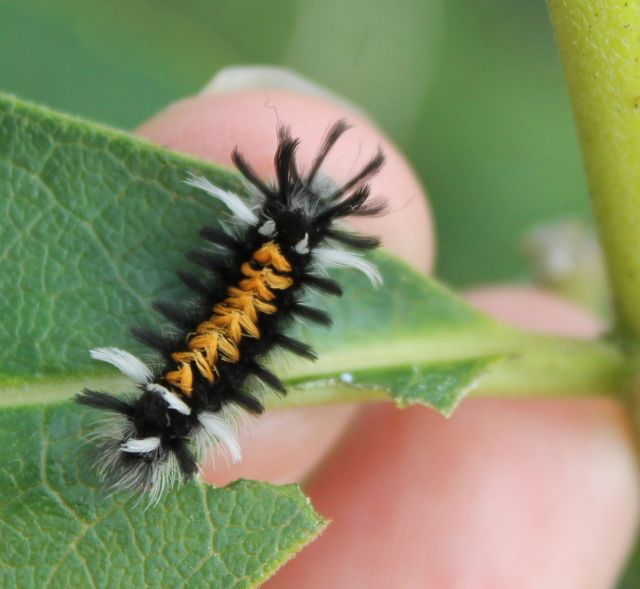
Few Monarchs but lots of Milkweed tussock moth caterpillars!

The milkweed pods are huge.
Soon, they will be flying like snow.
.
Fuzzy-wuzzy caterpillar
They are everywhere.

I spotted only a single Monarch this year.  Their population is estimated to be down by 80% due to 2012 drought. The Milkweed tussocks are cleaning up! It doesn't harm the milkweed, as they have happily produced seed pods. They are ripe with seed pods, hanging heavily from the plants.
Our fields are densely populated with milkweed.

I was fascinated with them. I took a walk yesterday and spotted four of them all lined up, efficiently grazing in a row. Daisy and I didn't have the camera. They make me think of my macrame days, when we made anything, or the endless rug-hooking we did.

These moths lay two broods, especially in a good year like this one. With luck, the Monarchs will come back, too.
The caterpillars look like they aren't real, made of wiry wool, with lovely orange, black and white colouring.
Isn't it sweet?
My attempt at a drawing.
Interesting moths.
I scoured my files to find a photo of a Milkweed tussock moth, and failed. Instead, I decided to draw one, rather than steal an image, based on a series of photos on bugguide.net. The white moth I have has spots, which these guys do not posses. The specimen images seem to be more of a buff colour, but ID.net says they are grey.

I'm sure the ones in some of the photos are dead, as it is tough with some moths to poke it enough to peek at the underwing. I've been getting more bold with them, and pulling out the Tiger moth's orange underwing. My large Imperial moth, 4" across, who sat on my front fence for 24 hours, was quite brave.
This might be close!
Bipectinate antennae
Either way, it is late in the season to see them. I played outside in the lights in the dark and couldn't spot any. 

They have cool antennae, with little feathery bits on either side, which means it is a bipectinate antennae. It can be pectinate, with feathers on one side, or filiform (none at all). Butterflies have a clubbed antennae.

Imperial moth,
is the diameter of my finger.
The same feathers on the head!
This one is close to the Tussock
but not quite.
They are fuzzy-wuzzy headed things, feathered almost, with a soft gray colouring, depending upon the photographer. The underwing and forewings are not coloured much. Their hidden bodies are a bright golden yellow, and yellow band with a dark spot. 
I submitted my post to Paint Party Friday, hoping to be further inspired and motivated to sketch a bit more. 


Thursday, 30 May 2013

The moths are out!

Imperial moth - wee one

Still there this morning

Tiger Moth - an 'underwing'
This Imperial moth was huge! 
Tolype velleda

Saturday, 28 July 2012

Like moths to the flame


Cabbage Moth
I have done quite a few photos up of my butterflies, with moths taking a lesser role. But living where we are in rural S.E. Ontario, I am finding some larger moths that have caught my camera's eye.

There are many Identification Tools on the web. I prefer to use BAMONA, with the pros telling me for sure what I have found!
We know that the Internet is more of a cybergarage sale, rather than an encyclopedia of trusted sources with gems here and there, but also lots of junk. I hesitate to name new species to me. I loathe leading people astray, as some are wont to do.

Did you know? National Moth Week July 23-29, 2012
Why moths? With more than 10,000 species in North America alone, moths offer endless options for study, education, photography, and fun. Moths can be found everywhere from inner cities and suburban backyards, to the most wild and remote places. The diversity of moths is simply astounding. 

Visit the National Moth Week website for more information, or read the press release (pdf).

This was out in the day - just lovely!


They inspired me:

Nighthawks
The cats want out in the dark to play
Coyote howls keeping them at bay
Jenny sits on the porch with the bugs
Mosquitoes try to give more than hugs
Moths they flitter: fragrant bloom to bloom
Tree Frogs eyes glitter for prey they swoon

The Tree Frogs love the dark. I have one that lived in our mailbox last year, but this year is hanging out in a plant our aunt gave us!
They must get their fair share of moths, drawn to our lights at night. They leave their tell-tale poo on railings for me to clean up in the morning.

First are the smaller moths I've spotted. I apologize, but Moths are not my speciality, I'm not sure if I want to purchase another moth book, although there are several available.

For moth identification assistance, try the North American Moth Photographers Group, the Cirrus Digital Imaging site, or John Snyder's Web Images of North American Moth Species
I can name some, not others! There are so many out there, and very hard to photograph in the night. There are a couple of diurnal moths, still hard to photograph for this amateur!


Synanthedon acerni – Maple Callus Borer Moth From moths


For all of my photos: From moths
Imperial Moth 4", it was!
Then the larger ones: an Imperial Moth.  It was the size of my hand! It was IDd for me by a pro. I didn't have a clue! More photos are here.
From moths
This is the latest, I spotted it during Moth Week, in the evening.
A bit blurry, as it was in the dark, with the floodlights on!
Can you see its proboscus?


Here is a better view - flighty thing!
CC #225