Showing posts with label history. Show all posts

Sunday, 8 December 2013

Generations Inn –a new spot to visit for food and lodging

Generations Inn

Hubby picked up a wonderful new glossy magazine that offers some new place to dine. We've made it out to two this past week. (I know - I'm spoiled rotten!) Here is one we visited on the spur-of-the-moment after dental appointments!

Generations Inn in Carleton Place

The building is 100 years old that has been lovingly restored. We offer a beautiful conference room for meetings. In addition, we have boat docking for our guests. This is a great place to have family reunions and group meeting as well corporate team building. We provide a natural setting on 7 miles of beautiful lake.

There is something about a place that offers a beautiful ambiance, as well as good service and great food. This Inn is a very old building, which our server told us has been renovated over 10 years. We have many old buildings like this in Lanark County, which was settled in 1816. They demobilised the Scottish military, and granted 600 acres of land to the officers.

They were interesting times, in some respects. The officers planned the town of Perth, for example, with money and resources to establish it for business and profit purposes.

Cottages, as well as B & B
I've been reading Whiskey and Wickedness, by Larry D. Cotton. He writes of a time when the "curse of Canada and the military" shaped a lifestyle. Disbanded and retired military, you see, were well-educated and well-pensioned. Not only this, but they also represented a culture of drinking, often to excess. In the 1830s the demand for beer was insatiable. The town was full of retired military men who were allocated a daily ration of beer, as part of their pension, from the British. The ration, a penny a day, could buy them 5 pints of beer, or some equivalency in whiskey or other "ardent spirits." Death caused by accidents, incidents of violence, or illnesses, vigilantism, including violence and murder, was a huge part of life in these early days.

The region was also full of hotels and saloons, with many profiting from drink! These were towns were people often stayed over, in a time when moving from Kingston to Ottawa took quite a long time. There were reports of much drinking and fighting, some between spouses. They weren't the 'good old days' by any means! Theft of goods was rampant, with a man named John Wills, the "Rideau River Pirate" who lived near Portland in the 1860s. As quoted in the book, from a newspaper account of the time,
"Wills appears to be a pirate by nature as he has always carried on his business by means of boats. He has been known to make trips via the Rideau Canal as far as Belleville. He steals everything from boats to silverware." (p. 51)
He was arrested in Port Elmsley in March 1874, assaulted the constable, and escaped, only to be caught later. These are the people that early settlers had to deal with. The land, with shallow soil, was difficult to farm. It took quite a family to manage to clear their allotted land, and earn a living. Many were able to establish farms, hotels, distilleries, taverns, saloons, on land, and near the bodies of water that were transportation systems across the eastern edge of the province.
Smiths Falls, for example, had a population of 800 in 1852. By 1881 it had increased to over 2000, requiring constabulary to be vigilant and ever present. Many were rather inefficient, however. Stories such as this predominate in the newspapers: The Fort Hemlock Riot of 1868. Fort Hemlock was destroyed by flood in 1904, in a story which speaks of theft and disputed ownership.

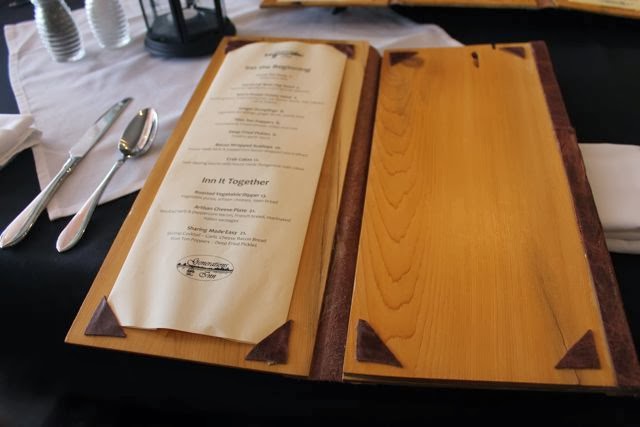
This is the history of a time and place, largely unspoken, but tells of a time when properties changed hands and people went in and out of business. It is wonderful to visit this old building, which has been renovated and preserved, giving it dignity in its old age, as well as a new purpose in life. There are room available for staying over, and I'm sure it is a very busy place in summer. We were delighted with our meal. The owner created these amazing menus, on wood and held together with rawhide.

Wednesday, 4 September 2013

Our Man in Tehran; Ken Taylor, the CIA and the Iran Hostage Crisis

I rented the movie, Argo, but found it pretty Hollywood-ish. Curious about the backstory, I picked up this book. Wright utilizes autobiographies and documents, now released in the 34 years since the event took place. I asked hubby to read it, too.
This is hubby's summary, based on about 5000 pages of reading he's done over time. He's is quite the history buff.

Book Review

Our Man in Tehran describes one of the results of this situation and the actions by both the Americans in Iran, the Canadian ambassador, Ken Taylor, and the the actions of the official government of Iran, and the real controlling power, of the Ayatollah Khomeini. The book is a relatively easy read, even for the non-historian. It gives a more realistic perspective to the events of 1979-80, than the recent movie, Argo.


Why was Iran in this situation?

The initial situation in the middle east, including Iran and Iraq, occurred after the end of WW I, with Treaty of Versailles  in 1919. For those interested, this is particularly well-covered in Margaret McMillan's book: Paris 1919. Simplistically put, countries in the middle east were formed not based on religious or historical territories, but on the boundaries of former European colonies. This natural dissension within these countries was further exacerbated by western interference in the selection of Middle Eastern governments, such as the CIA-based 1953 Coup in Iran.

Treaty of Versailles 1919

The thrust of the plot begins, according to history buff hubby, when country boundaries were redrawn after WW I, which crossed sectarian lines. All to keep Germany from keeping power. This was a result of the Treaty of Versailles, signed in 1919. Despite the common history, geography, economics, and cultures, religious sects divide a country without representation. According to History Learning Site UK: Germany had to return to Russia land taken in the Treaty of Brest-Litovsk. Some of this land was made into new states: Estonia, Lithuania and Latvia. An enlarged Poland also received some of this land. There are 9 million Muslims in Russia. I didn't know this until I did some research.
From an Election Unit of Study in 2005
My students were fascinated with this.
Dec. 15, 2005 article

1953 Coup

The 1953 coup in Iran, backed by the US and UK, overthrew duly elected officials after an election. All in the name of oil. Coincidentally, Deutsche Welle Radio takes a look back at 1953 coup featured a piece on the 1953 coup, all background to the hostage crisis:
On August 19, 1953, the democratically elected government of Iran was overthrown with the help of the US and the UK. The coup saw the formation of a military government under Shah Pahlavi. The oil industry was denationalized with half of profits going to Iran and half to a consortium of 17 mainly US and UK companies, and the shah received massive support from the United States. Shah Pahlavi created a dictatorship with the military, financial and personnel support of the United States. 

Sectarian Violence in Syria today

Colonialization has torn up many a country. Sectarian violence has done so, as well. Tribal Lords and religious leaders influence and/or control governments. The sectarian violence between Muslim Sunnis and other Muslim Sects, harms its citizens. The same is true of many tribes, such and the Hutus and the Tutsis, in Rwanda genocides.

WIKI Foreign Involvement in the Syrian Civil War
Map of countries surrounding Syria (red) with military involvement.
Green: Countries that have given support to the rebels.
Blue: Countries that support the Syrian government
Yellow: Countries that have groups that support the rebels 
and other groups that support the Syrian government.
Sky Blue: Countries that have groups that support the Syrian Government.
  Hindu-Muslim Conflict, Pakistan and the Partition of India.
The tension between India and Pakistan is rooted in religious violence that began during the 7th c. invasion of Muslims into India.

The USA and the UK, backing particular leaders friendly to their cause (obtaining oil), become too powerful. This is why the events in Syria worry many. It was interesting news that the UK voted against becoming involved this past week.

Syrian Regime and the Rebels

With nearly 2 millions displaced people in Syrian, the Syrian Regime is trying to keep power. The poisoning and deaths of their citizens truly frightens many of us. They say that the Russians, Iran, the Hezbollah, and Brazil, amongst others, are funding arms for the Syrians. Turkey has a Syrian-staffed command centre in Istanbul. The rebels, backed by western governments and Saudi Arabia, can do nothing but cause more harm to civilians. This is why this is a good book. It deals in the history that led to the conflict in Iran. It isn't onerous reading, for those who wish to understand more you can see how the various governments and agencies fight for power and control.

Canadians, by turn, are pretty placid, what with Prime Minister Harper's appointed Senators who have been found guilty of fraud. PM Harper has faced scandal after scandal, passed Omnibus bills with buried changes that set us back many years in terms of the environment, and health and safety. Yet as he reprorogues government, again (3x's now), we just take it. The media doesn't seem inclined to react. Voters are going to have to make some noise.


From the book publisher:

Our Man in Tehran: Ken Taylor, The CIA and the Iran Hostage Crisis

The world watched with fear in November 1979, when Iranian students infiltrated and occupied the American embassy in Tehran. As the city exploded in a fury of revolution, few knew about the six American embassy staff who escaped into hiding. For three months, Ken Taylor, the Canadian ambassador to Iran—along with his wife and embassy staffers—concealed the Americans in their homes, terrified that Ayatollah Khomeini would find out and exact deadly consequences.


The author

Trent University Oshawa Professor Wrote the Book on Ken Taylor ...


 Trent University History professor and author of Our Man in Tehran, Dr. Robert Wright accompanied Canadian hero Ken Taylor to the Washington premiere of the Hollywood film Argo. 

Click icon for more
book review blogs
@Barrie Summy

Friday, 1 July 2011

Manual airline reservations prior to computers!

Life before we had computers... Brian, my husband, and JL, my son-in-law, speak of the development of the reservations system in the airline industry. Before computers: who can imagine this? It involves stickers and is almost as bad as communicating with tin cans. It involves clothespins and early computer development. Jean-Luc, our son-in-law and a software encryption engineer, speaks about NORAD taking over the technology developed by the airlines, to assist them when computers were first invented.
Hubby joined the airline in 1979 at the data centre.
People remembered when customers would phone in, have the outline of the airline on stickies.
When you booked a seat they put the sticky on particular seats, and put the others onto a cardboard piece of paper onto a clothespin where it went onto a clothesline and into central source in another office.
Pneumatic Tube internal mail system, Commerce Bank ca. 1931

Flights were written in long hand, page after page. Every page added by day, week, month and year by column. Senior management were young, in their 30s, personal computers were so new that they though that two people could share a computer. These were dumb terminals, not PCs. They were at the forefront of the industry, using large data systems. The first sale of a computer was to American Airlines. IBM sold it, after talking to an AA senior president. They thought the market for computers was about five. The first discount airline was having the carriers for breakfast, as they could manage sales. American invented inventory control. Now used for hotels, airlines and drove Peoples Airline out of business.

Then, I found this one.


Now, you can track a flight online.


Thursday, 9 December 2010

Perth is perky in winter

I had an appointment in town. A chilly day, it pays to bundle up. I thought of my teacher friends out on yard duty. Brrrr. It is joyful to walk outdoors when you want to. Lovely to see the deep blue of the sky on such a cold day. It was -13 C. this morning.


I do not miss my lake too much!

icy shores

Here, a river runs through. 


Such old buildings

Perth military settlement 1818
"Scottish emigrants, quartered in barracks at Brockville during the winter of 1815-16, and soldiers discharged from the Glengarry Light INfantry and the De Meuron and De Watteville regiments, formed a majority of the original settlers. In March, 1816, a central depot was established on the site of Perth, and by October the settlement contained some 1500 persons."

Thursday, 28 October 2010

Historic Lanark County

We passed this old farm house on our way to vote.

Voting transportation: different in rural Ontario!

Can you believe this?

A long gone building - such history

Lovely sights, right on the river
An antique store - note fencing

Ancient Perth Shoe Factory!

Wednesday, 13 October 2010

Seeing a man about a fence

Yesterday I posted about our fences. Today, I'm writing about our plans. 

The Perth area, in Lanark County, our new home town, has a very different geology than Muskoka.
[A Short Geological History of Lanark County] This means different gardening style and different foliage. Still a mixed forest, but a range of wetlands, shallow soil, lots of cedar, dead or dying elm trees (Dutch Elm disease, hitting E. Canada in the 40's) and limestone that rears up in protest to its burial. 
Scott Dobson explains his work


Many of the Scots who settled in this region began to farm. Which isn't a difficult thing to do once you claimed your land grant, cleared the land, built a shelter, built fences for livestock, and dug in, so-to-speak. Not so simple a task, of course.

garden elements
The issue with this region is the limestone layers of rock. There is a lot of underlying flat rock in many places. I miss the pinks and grey granite of the Precambrian rock in Central Ontario's Muskoka, but have learned to embrace the beautifully flat slabs that allowed the first homeowners to build, for example, a flagstone-type walk through our front garden.

Our lot #2 is undeveloped and as I walk it I realize how much work went into collecting all of the stones to create our open lawns. Also, how many different types of heritage fence we have.

During the recent Arts Tour, we met a man who builds and repairs split rail fences and creates lawn designs. They are as much art as a brilliant recycling.

Scott Dobson was explaining that there was some competition from these transplanted Scots, to invent a new style of fence to accommodate the shallow soil of this region. In fact, the fence style was patented, hence the term 'patent rail fence'. Farmers battled to profit from their ingenuity.  The fencing is strong and lasts a long time, as well there is no digging into the ground!
Different fence style models

Each domesticated animal needed a different height fence, of course.
 Rather like the publish or perish mindset, patent rail fences were guarded and men like Closs wanted the fame and glory of a 'patent' fence. You needed a permit to build his type of fence. Others, Patton, McUvan, Drafer, also created variations of the split rail classic patented rail fence.

The Eastern White Cedar fence lasts many years. It is resistant to bugs, rot and weather. The perfect medium after farmers cleared the soil and had cedar wood lying around.

If you want to build such a fence, there are directions on-line. Click on the photos and you will download a PDF file. Scott is an expert. We are hiring him, and his crew, to create something for us. We are looking for 150' of fence to finish off our front, and create a landscaping treatment that will fit into the community.

Scott is quite famous in these parts!


Old cedar fence parts valued as pieces of art

By Lynn Saxberg, Postmedia News August 21, 2010


These are heritage pieces all about this land, that reveal the nature of the Scots and Irish that settled here. It has character.

Sheep fencing


fencing allows for the undulating hills

Ye olde farm house

Split-rail fence with four supports