
It seems as if our bird lovers at
Nature Canada (a registered charity and lobby group) have got it in for cat lovers. The debate continues as they seek fundraising dollars. They had a feature on In Town And Out (CBC tax-funded broadcaster),
Bird Tweet of the Week, to educate listeners about birds. (
I've written about this before
- as
a cat owner and a meat eater.)
They've gone a little far...

CBC Radio interviewed:
Ted Cheskey of Nature Canada. Cheskey stated the following as facts.
- 10 million cats in Canada (2 million feral cats, 8 million owned cats).
- 44 million birds killed annually by feral cats, less for domesticated cats.
- 200 million birds estimated to be killed: bird populations, he says, are declining. [Which birds? At-risk/endangered species aren't the birds domestic cats kill.]
There is a lack of direct research, it's complicated. Extrapolations based on cat owner reports,
individual cats tracked, and extrapolated data. They call it a 'stochastic model.' Fair enough. Best guesstimates.Yes, one cat followed snagged 10 birds.
This is not the case for most cats. If you are going to follow a cat, pick one that hunts birds.
My cats do not hunt on -20 C. days, nor rainy, really buggy days (when insect eater birds abound) or 30 C. hot, steamy days. Cats have different behaviours depending upon their breed, sex, nature, nurture, environment (rural/urban; climate), age, and health.
 |
We have a healthy Mourning Dove population.
They're pretty flighty, and can't be caught! |
However, there are so many variables that the results not only seem wrong, but it raises the ire of tree huggers, in order to get press and lobby against cat lovers. This must mean great PR and an increase in donations to these lobby groups.
Tree Hugger loaded cats with cameras: 2.1 bird kills per week of cats they followed. "The cats they followed" have not been demonstrated to be representative of ALL CANADIAN CATS!
"The results of the study showed that of the 60 cats wearing the cameras, 30% captured and killed prey (including mammals) with an average of one kill for every 17 hours spent outside, or 2.1 kills per week."
I'm not the only one who believes that this is wrong information.
Barbara J. King (author:
How Animals Grieve) wrote a US article, and she agrees with me:

If you read the fine print, most of the birds killed by cats are ground feeders, feeding under bird feeders. SPCA polls reveal too many cats in rescue facilities. Too many people dump cats in the country, or don't bother to have cats spayed. This is where we focus. Let's change the things we can change.
 |
Forest cat walkies
Three of my 4 cats |
The grand pronouncement that we should keep all cats indoors doesn't work for many of us. We go walkies almost daily. We rely on our rural cats to keep the rodents down.
I love debates, except that it usually turns sour on Social Media. Name-calling, widely retweeted succinct and acerbic put-downs by those who disagree, misrepresentation by huffy treehuggers, who loathe cats, are the result.
Most cats do not venture into the forest or wetland to kill birds, this is what the studies say. They prey under human-placed feeders and kill small birds. These are not birds at-risk. Any death is sad, but if humans feed birds in the crowded city...
I think it is important for all Stakeholders to be considered
Nature Canada has been lobbying. Only it isn't a study, it is a
meta-analysis. A study of the studies. Do you know how many birds there are in Canada? Me, neither. Nor does StatCan collect data on pets, rural or urban, feral or stray cats.
"
Statistics Canada does not collect data on the number of pets (including cats and dogs) or stray animals in Canada."

We rely on polls. This is a fair enough extrapolation, but it doesn't explore which cats are good hunters, which cannot be bothered (species/sex/age?), or which belong to the hunt-and-release program, like our Dorah. It doesn't tell us which cat-owners are responsible and irresponsible. Talk those rural property owners who complain bitterly about those who dump cats in the country.
As with any research the data is dependent upon reliability, validity and statistical analysis. I liked math more than I liked science, but having peer-reviewed quite a few research papers for journals, I like to wrap my brain around good studies. I saw many inconsistencies.
I read the study, examined the referenced papers and found them sadly lacking.
Read the fine print:
The majority of studies relied on for predation rate of feral
cats (Table 3) are over 50 years old.

 |
| Table 3 –numbers fluctuate wildly |
One doof claimed that studies show cats get 10 birds a day. Where did he see THAT? I've had 14 domestic cats in 58 years, and they weren't outdoors that long. They sleep hours in the day, and songbirds aren't at the feeders at night. The nocturnal cats (male, black, fierce) are hunting mice. Not even ten a YEAR. Our male, black cats are the worst at night, but bring home mice.
 |
This isn't supported in the research.
And 'peer-reviewed studies" doesn't mean they are scientific methods. |
From: Table 3
 |
Sharp-shinned hawk
gets more birds than our cats
|
 |
| The fine print |
- Evidence that rural pet cats kill more birds on average than urban pets is based on relatively few reliable studies.
- There is little evidence that cat predation has an impact on most birds in an area.
- Only one (Barn Swallow, Hirundo rustica) is frequently present in urban and suburban landscapes. Predation by cats is mentioned as a concern in status reports or recovery plans for at least 10 of these species, though in no case are house cats listed as the primary threat to population viability.
Environment Canada report on avian mortality (2013 -pdf) [Authors pay $750 to publish in the Avian Conservation and Ecology Journal.]
WHY do birds die?
Habitat loss, windows, vehicle collisions, offshore oil and gas structures/exploration, forestry production, transmission lines, mowing and mechanical operations, and predators (domestic and wild). These are things worth doing something about, some are easier than others.
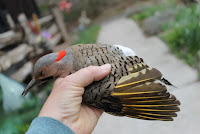 |
This Flicker hit the window.
Shall we remove all windows in our homes? |
Analysis aside, why is it nature lovers and people in power feel they can lecture cat owners? Most of us are nature lovers, too. We feel badly when any critter dies. Then, there are humans who are artificial bird feeders- who ignore the logic and common sense of this practice. Why doesn't Nature Canada get these groups together and come up with best practices for all? Don't feed city birds. Have your cats fixed.
With deermice carrying Hantavirus, a zoonotic disease, I need my cats to keep the mouse population down. And they do. In high numbers. They bring in 20 rodents to 3 birds. Actually, Dorah brings them in. Daisy brings Deermice onto the driveway. Annabelle brings hers up on the front deck. Buster brings field mice up onto the back deck.
 |
| cat collars did not work |
 |
Buster broke a tooth
likely from falling from a tree |
I tried collars on cats. It just didn't work. Cats who climb trees are at risk of death, when collars get caught on branches.
Lobby groups, like Nature Canada, need to listen to ALL Stakeholders
Cat owners
The responsible ones do some or all of these things. The irresponsible ones do not, and will not respond to municipal legislation.
- Keep cats from having kittens, it is silly having your cat have kittens, just to let your kids see them give birth. Visit a shelter.
 |
| Hawk chased this Grouse into the window |
- Adopt from shelters.
- Have your cats fixed.
- Watch your cats.
- Use cat bells or leashes. (Doesn't work if they are older or rescue cats, like ours.)
- Play with them, keep them active and tired.
- Monitor their activities; know when they are likely to act as predator (diurnally).
- I take ours for forest walks.
- Educate cat haters; educate bird lovers.
- Educate those who shouldn't have cats, never mind children.
- I'm home most days, and can see them in the yard, and I take responsibility for what they do in the daytime. While they roam free, they roam on my property, usually in the grass hunting mice. (20: 1 bird)
Cat haters and bird loving-humans
 |
Ollie didn't get any birds,
despite being able to
jump into the feeder!
(He was killed by a car,
across the highway hunting mice.) |
- Ensure that you are feeding birds seasonally. They don't necessarily need food. Why lure a cat if you don't need to?
- Keep bird feeders away from windows.
- Bird lovers spend big bucks on squirrel-proof feeders, worry about cat-proof feeders, too.
- Care for the area around your feeder, remove grass and other places predators, like cats, may hide.
- Clean up spilled bird seed and bring feeders in at the end of the day.
- Feed only enough seed as can be eaten.
- Keep feeders bear-, raccoon-, and coyote-proof, since you encourage all wild animals with feeders.
- Refrain from driving at high speeds, in the dark. Road kill is a terrible thing for many critters, including birds.
- Somebody educate citiots. You cannot dump a cat in the country. This is what led to our Annabelle being a wicked hunter. She had to live in a barn to survive until our vet took her in and we adopted her. This is the same for our Dorah and Daisy, abandoned with their mother.
This is the background of the study.
METHODOLOGY is pretty questionable
A. Birds killed per year by urban pet cats: Urban cat kills = #Pet Cats x (1-proportion rural cats) x proportion Outdoor cats x average # birds returned to owners x Adjust
B. Birds killed per year by rural pet cats: Rural cat kills = #Pet Cats x proportion rural cats x proportion Outdoor cats x average # birds returned to owners x Adjust
C. Birds killed per year by feral and stray cats: Feral and Stray pet kills = #Pet Cats x average # feral cat kills (stomach contents)
Therefore the total birds killed per year = A. + B. + C.
What don't we know?
- What is ADJUST? "Adjust is a multiplier to convert birds returned and detected by owners to birds killed by pets" Say what?
- Which species of cats; gender, age, weight, a hunter or non-hunter. They vary.
- Although it is known that there is a large and growing population of feral cats in Canada (CFHS 2009), there are apparently no scientific estimates of their numbers.
- True population counts of songbirds.
- How many of these birds were old, sick, genetically unviable?
- We don't know what barn cats kill.
- Is there a difference between climate, weather and cat kills? (Winter vs. summer)
- Not all birds are susceptible to cats. Most fly away...
- Bird deaths in the millions lead to government, industry action(CBC -Sept. 2013)
Research
Flux, J. E. C. 2007. Seventeen years of predation by one suburban cat in New Zealand. New Zealand Journal of Zoology34:289-96. http://dx.doi.org/10.1080/03014220709510087
[Conclusion: the 17 years this cat hunted had no impact on long-term population anything other than rabbit populations, based on a previous 15 years of data.]
Research Paper, part of a special feature on Quantifying Human-related Mortality of Birds in Canada (ACE) (Not an unbiased data source!)
Grey catbirds: "
To date, few studies have quantified both nest success and post-fledging survival for birds breeding within the suburban matrix. Here, we estimated nest success and juvenile post-fledging survival for Gray Catbirds (Dumatella carolinensis)" Predation account for 76% of mortality, 47% of kills attributed to cats, but they survive through reproduction.
My data
Every death breaks my heart. That said, with illness in my family, and the tolls of doing hospice work and daily life, we depend upon our cats for relaxation, joy and sheer entertainment value. I've
caught and released bats from in the house.


