. |
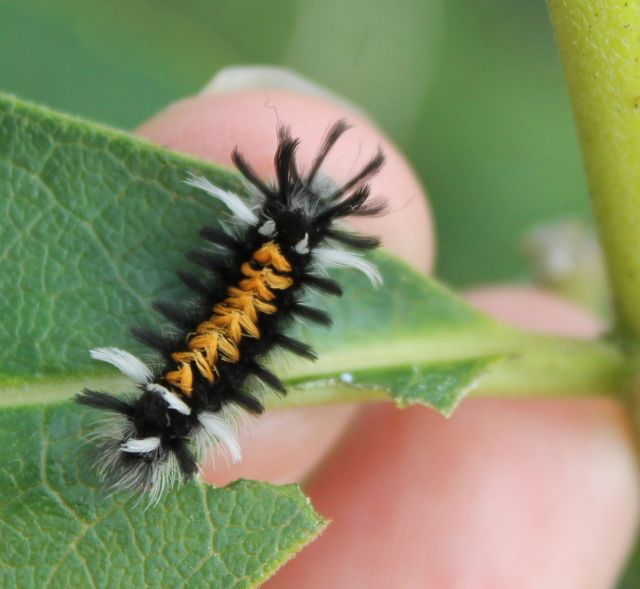
| Fuzzy-wuzzy caterpillar |
They are everywhere.
I spotted only a single Monarch this year. Their population is estimated to be down by 80% due to 2012 drought. The Milkweed tussocks are cleaning up! It doesn't harm the milkweed, as they have happily produced seed pods. They are ripe with seed pods, hanging heavily from the plants.
Our fields are densely populated with milkweed.
I was fascinated with them. I took a walk yesterday and spotted four of them all lined up, efficiently grazing in a row. Daisy and I didn't have the camera. They make me think of my macrame days, when we made anything, or the endless rug-hooking we did.

These moths lay two broods, especially in a good year like this one. With luck, the Monarchs will come back, too.

The caterpillars look like they aren't real, made of wiry wool, with lovely orange, black and white colouring.
 |
| Isn't it sweet? |
 |
My attempt at a drawing.
Interesting moths. |
I scoured my files to find a photo of a Milkweed tussock moth, and failed. Instead, I decided to draw one, rather than steal an image, based on a
series of photos on bugguide.net. The white moth I have has spots, which these guys do not posses. The specimen images seem to be more of a buff colour, but ID.net says they are grey.
I'm sure the ones in some of the photos are dead, as it is tough with some moths to poke it enough to peek at the underwing. I've been getting more bold with them, and pulling out the Tiger moth's orange underwing. My large
Imperial moth, 4" across, who sat on my front fence for 24 hours, was quite brave.
 |
This might be close!
Bipectinate antennae |
Either way, it is late in the season to see them. I played outside in the lights in the dark and couldn't spot any.
They have cool antennae, with little feathery bits on either side, which means it is a bipectinate antennae. It can be pectinate, with feathers on one side, or filiform (none at all). Butterflies have a clubbed antennae.
 |
Imperial moth,
is the diameter of my finger.
The same feathers on the head! |
 |
This one is close to the Tussock
but not quite. |
They are fuzzy-wuzzy headed things, feathered almost, with a soft gray colouring
, depending upon the photographer. The underwing and forewings are not coloured much.
Their hidden bodies are a bright golden yellow, and yellow band with a dark spot.
I submitted my post to
Paint Party Friday, hoping to be further inspired and motivated to sketch a bit more.






 These moths lay two broods, especially in a good year like this one. With luck, the Monarchs will come back, too.
 The caterpillars look like they aren't real, made of wiry wool, with lovely orange, black and white colouring.