Showing posts with label tent caterpillars. Show all posts

Monday, 4 June 2018

The eastern tent caterpillar (Malacosoma americanum)

UPDATE: June 20th

Our lilac has a bite out of most of its leaves. All is well, though. They have cocooned!

UPDATE: June 8

They are massing on trees to do their instar, again!


UPDATE: An interesting article!

Oriole, eating tent caterpillars! A lot of birds do NOT eat them, since they cannot digest their furry shell.

May 27th
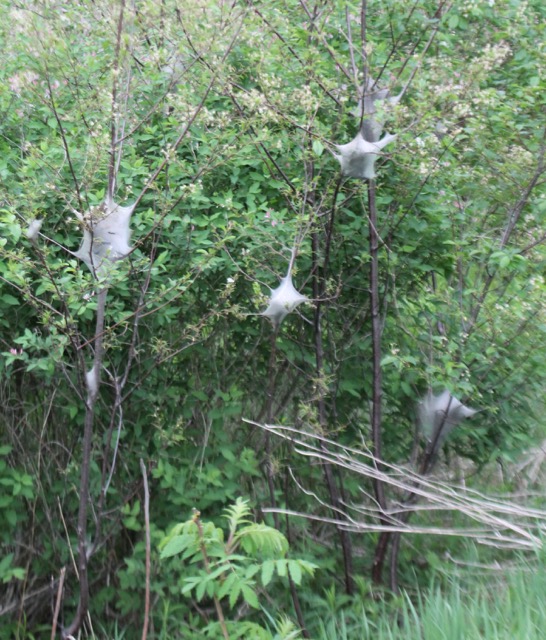
As we travelled to Chesterville and Long Sault, I noticed a lot of forest tent caterpillars. Then, I spotted some here at home!


The pupate a couple of times, and grow larger.


From Wiki:
Under field conditions, the caterpillars feed three times each day, just before dawn, at midafternoon, and in the evening after sunset. During each bout of feeding, the caterpillars emerge from the tent, add silk to the structure, move to distant feeding sites en masse, feed, and then return immediately to the tent where they rest until the next activity period. 
The exception to this feeding pattern occurs in the last instar, when the caterpillars feed only at night. The insect has six larval instars. At the last stage, the caterpillars disperse and each constructs a cocoon in a protected place. The adult moths, or imagoes, emerge about two weeks later. 
As the weeks passed, they started marching towards the house. Seriously! All on the porch, headed towards the front porch and the door.


The forest tent caterpillar moth!
The is the adult moth
They lay eggs on branches, which overwinter.
Egg casings are laid in August.

References

This was on Google. Heaven knows where it is from!
ENTFACT-423: Eastern Tent Caterpillar  |  Download PDF
Sometimes people confuse the fall webworm with tent caterpillars.

Natural Controls (Back to Top)

A wide variety of factors have been implicated in causing population declines, including several adverse environmental conditions. High levels of larval mortality have been associated with relatively low temperatures in the winter and spring (such as a late or hard freeze following larval emergence) and harsh weather when early instars are abundant. Harsh weather and extremely high temperatures may kill numerous adults later in the spring, and also reduce mating success and viability of offspring amongst survivors. Outbreak populations may also decline or collapse as a result of starvation, when larvae exhaust food supplies (i.e., host foliage) before completing development (Drooz 1985).
Natural enemies such as parasites, predators, and diseases may also exert important regulatory effects on Forest tent caterpillar populations. Some natural enemies are often extremely abundant during the later stages of outbreaks (Drooz 1985). The documented natural enemies of tent caterpillars are numerous, including 14 species of Hymenoptera egg parasites, 52 Diptera and 61 Hymenoptera species parasitic of larval and pupal stages, and 18 Hemiptera, nine Coleoptera and one Dermaptera that are predators of various life stages (Witter and Kuhlman 1972). At least 18 species of the parasitic insects have been recorded in Florida (Frank and Foltz 1997), as well as a parasitic nematode in the family Mermethidae.
Other known predators include frogs, mice, skunks and over 60 species of birds (Witter and Kuhlman 1972). Bird predation of late-instar and pupal stage forest tent caterpillars has recently been demonstrated to cause overwhelming mortality of populations at all densities in an artificial setting, and is hypothesized as the principle regulator of low density populations between outbreaks (Parry et al. 1997).


Forest tent caterpillars invading Winnipeg, says entomologist
CBC.ca
Rochon says forest tent caterpillars typically infest the city once every 10 to 15 years, but when an infestation hits, it can last two to three years.

Sunday, 10 May 2015

The ebb and flow of the seasons: tent caterpillars, grosbeaks, trillium

There are the seasons, the changing weather, climate, and there is Climate Change. We can't call it Global Warming, since there are places that are warmer, wetter or dryer, like California.

I've found it interesting to track weather data. My friend, Nancy, has log books from her family which recorded data: ice out, rainfall, etc. My data lets me know how much well water I can use, and if I should refill the goldfish pond! We've had half the rain of May compared to last year.

We missed all of this precipitation, sadly.
Climate – the larger patterns over a region, over a long period of time.
Weather - you can cite regional averages, but 'normal' can fluctuate. They can predict the weather for the weekend, but beyond that, you cannot be sure!

I was checking out the rainfall for last year:
May 2014 we had 166mm. The previous April, 2014, 160 mm rain. Compare this to April , 2015, only 84mm. If April showers bring May flowers, we're a bit short.

Critters depend upon rain, and many need water for reproduction. There are years that the bugs are decimated by a hot season, which affects the birds, others when they thrive.
My stacked wood has attracted many critters.
DRS and a spider. See it?!
Dock spider - they are immense!

The birds at the feeders have been amazing. My foot is healing, and I've been duly resting in on the front porch. I have spotted a couple of new species for me. A Gray Catbird, a flighty thing, only identified by its song, as well as a female Black-headed grosbeak. You can compare the female Rose-breasted grosbeaks with this one, much larger. I'm waiting to see the finery of the male! The white around her eye, the pale beak, and the double wing bars are clues. Her belly is quite pale, with some yellow. You can compare the two grosbeak bellies!


Three female Rose-breasted
female Black-headed grosbeak


Lots of people were out driving in the heat. Many going topless!

We took a backroads drive, on a dusty, dry road. I noticed a lot of the tents. This is going to be a banner  Tent caterpillar year! There were hundreds of thousands of them! They go in 10-year ebbs and flows, I've read.


At one spot, eagle-eyed hubby spotted a turtle. I rescued it, setting it in the direction in which it was going, across the road.
It took the No Trespassing sign to heart!

Such a cutie, Painted turtle


The Trillium are having a banner year. Trillium blankets the forest floor. Bright, white faces shine.
In Westport, swallows and a warbler of some sort! Look up, look waaaay up!
A lot of snappy dressers at The Cove, we had lunch on the patio.  It was good, but we just had pub food, chicken fingers! I did have a salad for dinner...
We like our hats, some of us!
Plus, a muskrat swam by.

Monday, 1 June 2009

Bugs in May: wind, rain, snow, sleet


What a surprise, wind and snow, with bugs galore. It is tent caterpillar season. I gathered the tent caterpillars off of the tree and fed them to the water creatures. My late parents planted this tree a few years ago, a crab apple, methinks. Very sad to lose it.