Showing posts with label Ctenucha virginia. Show all posts

Sunday, 15 July 2018

Monarchs and Milkweed, our frequent flyers

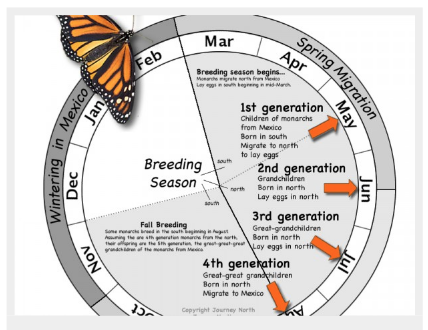
The annual cycle of Monarchs
The butterflies have been amazing. We have a lot of Monarchs, as well as Swallowtails, Eastern Commas, fritillaries. The annual cycle of Monarchs continues from their first breeding in March in the south, the adult migrate north, breed again, and again, until they make it to their northernmost breeding ground, just north of us. Finally, they do the reverse, with the last life cycle taking place in August - November in the south of North America. There are four generations each annual cycle that migrate north and south, until their winter habitat in Mexico.

migration: north and south

Here in south eastern Ontario, we are about 250 km south of their northern habitat. They require milkweed as a host for the eggs and caterpillars. We have plenty of those in Ontario! For their migration, they require pollen from any flowers, not only milkweed.

Friday, July 13th, Annabelle and I watched this one laying eggs. I checked. Sure enough! It just takes a moment. We're doing Gramma Camp this week, so my grandies can watch them!

Monarch 2 from Jennifer Jilks on Vimeo.

Life Cycle

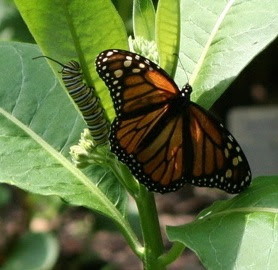
They spend 3 - 5 days as an egg. (It all depends upon temperature!)
Then, 11 - 18 days as larva (caterpillar).
Next, 8 - 14 days as a chrysalis. (Journey North provides this information.
It's hard to find an accurate source on the great garbage dump in cyberspace.

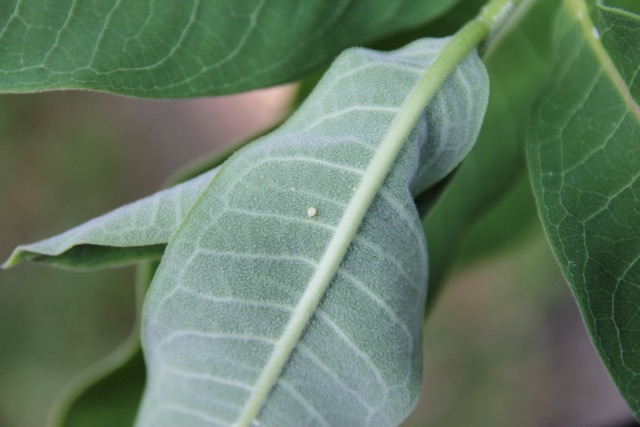
The eggs tend to be on the underside of the leaf, but not always.



Of course, lots of critters feed off of milkweed. The swallowtail, for example.

Also, bees, many milkweed tussock moths, red milkweed beetle, and Ctenucha virginia.
Milkweed plants from Jennifer Jilks on Vimeo.


This is an archive photo. The Port Carling library hosted monarch chrysalis to release. I know this a way down the line for us, but what a process.

Saturday, 4 July 2015

Another cocoon: Mourning cloak

Nymphalis antiopa Mourning Cloak
My expert at BAMONA says, take in the cocoons and shelter them. It is amazing to watch.

I use an old aquarium, with an old window screen. Carefully removing the cocoon with tweezers, I tied a string to the threads on the end. Then, I taped it to a piece of vinyl, letting it dangle as it was.
There are two on the go here. The brownish one is a Mourning Cloak butterfly. The other black one is a Virginia Ctenucha.
Left: Mourning cloak, right Virginia
Thursday night it began to change to black.
I knew it was nearly time.
They tell me they hatch in the morning.

Looks like a pretty, upside bat!

5:30 a.m.
My set-up: videocam on the tripod,
thermometer says 10 C., 'twas a cold night!

Sun is rising.
I had three helpers, with Daisy on-call in the Muskoka room beyond.
I set the camera to run, popping back over to it to shut it off and begin a fresh clip. I find this works better. Then, discovering that the spare battery was dying, I'd cleverly replaced it first, I figured I had to plug it all in. That was better.

Time passed. I read yesterday's paper, did some computing, today's blog post, had 3 cups of coffee. By 7:00 a.m., hubby got up. Still nothing. By 9:00 hubby was watching tennis. Raonic won. At 9:30, I figured I'd better get my workout done. When I came back upstairs, it had broken free!
It hung on it's cocoon for over two hours. I moved it to the railing, to be out of sight of cats.

Mourning Cloak emerges from Jennifer Jilks on Vimeo.
I waited all morning! The visible process took 10+ minutes, I sped it up 4 x's the speed. It took 2+ hours to rest and then fly away.

Thursday, 12 June 2014

Just when I thought...

Iridescent blue underneath!
...I'd documented all the critters out and about, I discover a new one.

Yellow head
Ctenucha virginia [CHEN-OO-CHA]
Iridescent blue - which warns predators about its bad taste! My Bugs of Ontario book tells me that this type of blue warning system is unusual this far north.

 
Virginia Ctenucha from Jennifer Jilks on Vimeo.
I was out getting a video of the firefly when I spotted this lovely moth.

Of course, I have no photos of the fireflies, but I managed a video last night. Don't blink, though!
Firefly from Jennifer Jilks on Vimeo.
About to turn in for the night, I spotted a Firefly in the front garden. I risked the bugs to capture a view.
In the meantime, Phoebe is still feeding 5 babies, and the bugs are quite numerous, flitting about in front of the camera!


Phoebe from Jennifer Jilks on Vimeo.
Bless their little Phoebe hearts! It's a bad year for bugs. They have 5 babies, all happily thriving in the shed, despite 4 cats.