It was a heckuva drive: Driving to Pembroke, in pouring rain. It was over two hours, and 264 km. We shall go back in better weather!
After the fabulous art show: Veteran's Voices - The Art Of Healing - Art Therapy Exhibition, Marillyn Saffery's art therapy clients, we had lunch at the bistro, then drove around some. We'll have to go back in a shoulder season to visit the museums. They are repairing a huge section of the main drag.
There was some fun decor for Hallowe'en.
Apparently, there is a Hydro Museum! Who knew?!
This was a drive-by shooting. I really don't know why he was taking a photo, but I enjoy taking photos of people taking photos!
Pembroke murals are famous. The celebrate the history of the area.
In 1613 Samuel de Champlain was the first European to visit the site, which by the turn of the 20th century had grown into a vigorous logging community. In 1884 Pembroke became the first community in Canada to have commercial electric street lighting and an electrically lighted town hall.
The murals feature a lot of white colonial settlers, which is typical of the area. All of these mayors are white men. We have much to do in the area of Truth and Reconciliation.
The Mayors of Pembroke: A Portrait Gallery 1877-2014 Artist Marillyn Saffery, Assisted by Shauna Torgerson 2012
I would love to see some more information on the First Nations of the region. The federal government has a lot to answer for in terms of treaty obligations. There was much harm done by the Catholic Church, the federal government, Residential Schools, and racism on the part of white settlers. The nun gives me the heebee jeebies!
Treaty 27 is a preliminary version of Treaty 271/4, which was signed in 1822. An annual annuity was paid in the amount of £2.10, and they were limited to 257 people ...
Known collectively as the Williams Treaties, the agreements which provided for ... and French Line and on the south by earlier treaties concluded in 1818 and 1819. ...... 27, the above Chippewas and Mississaugas surrendered to the Crown.
The Dakota pipeline protests caught my interest. Canada has a history of horrific tales of settler colonisation, and the theft of the land. The USA has a similar story of broken treaties.
This history is important to understand.
Out of interest, after I have been researching the history of the colonization of Canada. As a white person, I think it is the only response to The Truth and Reconciliation Commission. There are those who believe there is no possibility that settler colonisers can be reconciled. I'm inclined to disagree.
When you know better, you do better, if it isn't too late.
In the spirit of reconciliation, we must listen to their stories.
Many kids died in these schools, estimates of 50 - 60%. Kids ran away, only to get lost in the bush. We can make fun of the way the USA has treated First Nations with the #NoDAPL, but what Canadian civil servants and church employees and high-ranking church leaders have done.
I was researching the residential schools, I found the first report (1907), by the head medical officer for Indian Affairs, who spoke truth to power. He was fired.
The church and provinces expropriated treaty lands from Crown land, and then dragged kids away from home to place them into residential schools to make them more white.
Residential Schools were underfunded:
(We Can't Make the Same Mistake Twice). Taxpayers didn't want to pay for the schools. This was a photo taken to support increased funding by the Canadian Government. They celebrated turning Indigenous boys and girls into something they were not. The schools were underfunded, and were often filled with staff who were racist, if not sexually abusive.
Fig. 1: Department of Indian Affairs. Thomas Moore before Tuition at Regina Indian Industrial School. 1897. Saskatchewan Archives Board. In A National Crime. Fig. 2: Department of Indian Affairs. Thomas Moore after Tuition at Regina Indian Industrial School. 1897. Saskatchewan Archives Board. In A National Crime.
This award winning documentary reveals Canada's darkest secret - the deliberate extermination of indigenous (Native American) peoples and the theft of their land under the guise of religion. This never before told history as seen through the eyes of this former minister (Kevin Annett) who blew the whistle on his own church, after he learned of thousands of murders in its Indian Residential Schools.
He was appointed to the United Church in Port Alberni. After exploring the common threads of murder, abuse and residential schools, he spoke truth to power. I had no idea. I've heard the horrific abuses, and listened. I didn't know what had been perpetuated by The United Church of Canada, in a ploy for land, money and power.
Annett was attacked, after being warned to be quiet, had his PhD. blocked, and United Church staff blocked his subsequent employment in B.C. He was shunned by church staff and clergy. He brought the skeletons out of the closet.
Jan. 23, 1995 Annett had served as a minister for 3 years, and was fired without cause. The church paid for his divorce, and limited his access to his children. Without the knowledge and consent of his church members, and with the collusion of those in Toronto head office, as well as the RCMP.
Annett listened to their stories, and did more research. England deliberately gave people tuberculosis, by giving them blankets from those in hospital with TB. Then, it was small pox. The average death rate in residential schools was 50%. Murder, sexual abuse, medical experiments, hundreds were sterilised, unable to have children.
The United Church of Canada deliberately destroyed Annett, paid for his wife to divorce him and held a trial to de-list him for simply speaking truth to power. The 'Pales', as Annett calls us, didn't want to hear the horrific stories people told in Port Alberni.
The film: "We Can’t Make the Same Mistake Twice" exposes Canada's barriers to reconciliation https://t.co/eLddUPT8U3
20 minute history of Canada and the Indian Residential School system. To provide historical context and intended as a prequel to the video Murray Sinclair Truth and Reconciliation. Developed for School District 27 Grade 5/10 History curriculum.
KUPER ISLAND
Published on 1 Nov 2013
Return to the Healing Circle.
Residential School Survivors.
It was the Kuper Island Residential School, and it stood on a remote island off the coast of British Columbia. They called it Alcatraz.
For almost a century, hundreds of Coast Salish children were sent to Kuper Island, where they were forbidden from speaking their native language, forced to deny their cultural heritage, and often faced physical and sexual abuse. Some died trying to escape on logs across the water. Many more died later, trying to escape their memories.
Métis filmmaker Christine Welsh and Peter C. Campbell join survivors of the school, 20 years after its closure, as they begin to break the silence and embark on an extraordinary healing journey.
Much harm has been done by the churches, both Catholic and Protestants, i.e., Wahta Mohawks in Quebec.
The Wahta community was founded when a group of the Mohawk people moved from Kanesatake, Quebec to Gibson Township (Muskoka) in 1881. The conflict over land and religion were what brought about the move. The Catholic missionaries (of the Seminary of St. Sulpice, frequently termed the Sulpicians), Mohawks and other Iroquoians, Algonquins and Nipissings had occupied land at Oka, Quebec since early 1700, after a grant was made by the French Crown.
Sadly, this young man, Colton Boushie, was murdered in Saskatchewan. He wrote of the impact of residential schools on Indigenous Peoples. Education is so important.
More importantly, a seed has been planted in the consciousness of more Canadians about cultural appropriation, indigenous representations and identity.
Our home sits in the middle of a wetland. It is on unceded Algonquin land, where Indigenous people hunted as part of their summer hunting grounds. Ontario Treaties.on.ca
The first Algonquin petition to the crown was in 1772. Seriously. It was 244 years ago. Still racism, and settler colonialisation, has dominated First Nations. Lanark County land is part of the Algonquins of Ontario Land Treaties: Agreement-in-Principle (AIP). A treaty still unsigned. Their original territory was enormous, going right up to Algonquin Park (green, below) in central Ontario. Creating a treaty is a slow process, and not finished yet.
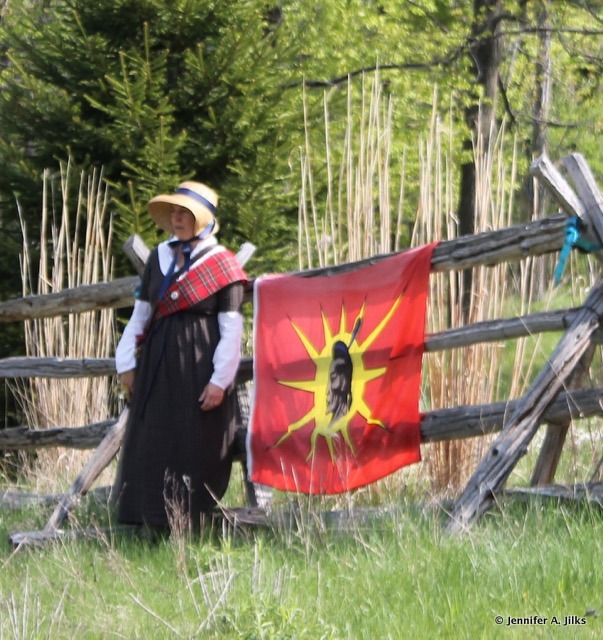
I set up flags during the 2016 Perth 200th Anniversary of the Trek. Scottish, UK, and a Mohawk flag decorated my fence. I had good conversations with a couple of people about this. We are on unceded lands.
This woman thanked me for honouring First Nations.
She is First nations descent.
Part of Reconciliation, surely, is listening to the stories. Recently, our Gord Downie (dying from a brain tumour) teamed with an artist to create Secret Path(YouTube). Secret Pathtells the story which was inspired by Chanie Wenjack, a 12-year-old Ojibwe boy, who tried to escape a residential school by walking home to his father. You can watch the video here. It was 50 years ago, some students fled the horror and the abuse by trying to walk home to their reserves miles and miles away. They perished.
Like so many, the iconic singer first read about the runaway in the pages of Maclean’s, in a 1967 story that drew national attention to a case that otherwise would have surely been forgotten. Chanie was enrolled at Cecilia Jeffrey School, also in Kenora, and all he wanted was to reach his father—in Ogoki Post, a reserve 600 km away.
These laws stated that settlers could only be given land after an agreement had been reached between First Nations and the Crown, with the decision being ratified at the 1764 Treaty of Niagara, “where delegations of Indigenous peoples from across what is now southern Ontario met and exchanged wampum belts with a representative of the British Crown.”
The 1840 address by Omamiwinini (Algonquin) leader Kaondinoketch describes a painful reality already existing a mere quarter-century into Perth’s history: “Our hunting grounds that are vast and extensive and once abounded in the richest furs and swarmed with deer of every description are now ruined. We tell you the truth, we now starve half the year through and our children, who were accustomed to being comfortably clothed, are now naked.”(reproduced by Ardoch Algonquin leader and Indigenous studies professor Paula Sherman, in the book At Home in the Tay Valley)
Seriously.
Presentation to G20, in 2009.
Some Canadians exhibit some smugness, including our previous Prime Minister.