Showing posts with label Great ash sphinx. Show all posts

Tuesday, 26 July 2022

COVID–19, Eavestrough and the moths

😷COVID-19 <= I've been keeping track of our local cases.

Things are heating up around here. Friday, July 15th, Ontario announced 2,105 cases of COVID. Ontario removed its masking mandate on March 21st when we had 1,217 cases. This daily case count is higher than both December 15th, 2021 and February 7th, 2022. 

They test high-risk cases, people in the ER, etc. And people who have access to the PCR tests, rather than the RATs, are a limited group. Not everyone can get one and you must be a front-line healthcare worker.  

Who is eligible for PCR or rapid molecular testing in Ontario?

We'll continue to be careful. We mask everywhere indoors.  

πŸƒπŸƒπŸƒπŸƒπŸƒπŸƒπŸƒπŸƒπŸƒπŸƒπŸƒπŸƒπŸƒπŸƒπŸƒπŸƒπŸƒπŸƒπŸƒπŸƒπŸƒπŸƒ

 Common Angel's Trumpet

Brugmansia arborea is an open treelike plant with 6-inch-long trumpet-shape white flowers with a delicate scent. It grows 6-12 feet tall.

This is why we cannot have nice flowers: potato beetles! Can you see it peeking out?! 


This is the seed pod. Like the many garden or household plants they are toxic. I grew some Bean Plants one year. They have similar sharp pods, and have ricin in them, which is poisonous. 

The coleus is doing well. The wild grape vine is working its way up to cover the blue cat.


These are the clouds that rolled in on Sunday, July 24.


storm July 24, 2022 from Jennifer Jilks on Vimeo.

Our new eavestrough was in a bad way. I turned on the front floodlights to check it out.

moth in the storm from Jennifer Jilks on Vimeo.


They came and fixed the eavestrough, again. (I'd sent a video.) They seemed grumpy, dropping the F* bomb on top of our eaves as they undid screws and changed the level of the eaves. Left without saying they were done. They warned me of the debris in the gutter, but it wasn't much truthfully. The angle of the trough needs to go from the high point to this, the drain point over the downspout. 


This is the fascia I thought they should have replaced. They told me they hadn't needed to during the original installation. We shall have to see what the next big dump of rain brings. 

eavestrough fascia from Jennifer Jilks on Vimeo.

It really is discouraging. I put my ladder away, and went out onto the back deck to read. There are two tree frogs back there. One must be a male, as it was singing. This one, our Vancouver grandie named her Maple, spent the day under the aquarium keeping me company.

πŸ›πŸ›πŸ›πŸ›πŸ›πŸ›πŸ›πŸ›πŸ›πŸ›πŸ›πŸ›πŸ›πŸ›πŸ›πŸ›πŸ›πŸ›

Happy Wanderers

They are in Amsterdam for a few days. Their trip to the Rijksmuseum was amazing. They rose early for a 9:30 a.m. guided tour. It sounded like a good idea, as the tour guide highlighted several sections of the museum. The art library is awesome. 

This was a photo by Isabelle!


Thursday, 1 August 2013

What a spectacle in the night: Sphingidae or sphinx moths are huge

Female Io - Automeris io moths,
are as large as the sphinx!
The Io moths and Imperial moths are large, but the sphinx tends to be  the most diverse.


I've managed to photograph both the Io caterpillar and moth. A tricky job, I can tell you.
Io caterpillar
Half the battle in IDing them is knowing your ecosystem, habitat range, and the likely species you might find.
Io moth with closed wings,
fabulous eyes on the underwing


The largest I've photographed was the Imperial moth. It was resting one summer morning last year, on our cedar rail fence right beside the house. More common are the sphingidae or sphinx moths.


Feeding at night
Large, Imperial moth
Io eating my Hops plant leaves!
They feed on tubular flowers, like my phlox, with their long proboscis.
Most, the Peterson Field Guide says, are nocturnal and are drawn to the lights.

Two nights ago we managed photos of this friendly sphinx, as well as a baby gray tree frog and a firefly.

Moth identification
I use the BAMONA website, staffed by volunteers, experts who help me identify the moths and butterflies. There are so many about.

More than 11,000 moths alone, with my Peterson Field Guide to Moths of Northeastern North America IDing only 1500. It does help when you understand the difference between a Silk moth, an underwing, and a sphinx!

Trapping Moths
Lovely markings on the sphinx
There are ways to trap moths, using sugar as bait is one. They also have fancy dancy traps, with a light in the middle, and a clear funnel to safely trap them. Some people have created their own Skiner traps using a light and egg cartons as a resting substrate. Their gossamer wings are fragile, and any people I know are against harming a creature in order to trap and photograph it.

Moth bait
Some moths understand that lights are fake, and you'll need nectar to attract them.
One mixture consists of:

  • a soft banana
  • a scoop of brown sugar
  • a dollop of molasses,
  • a glug or two of beer.
Paint this on a tree, or on a thick rope strung between supports. Watch out for the raccoons, though! Check it regularly.

Photographing moths
Imperial moth body
is the diameter of my finger
They are tricky to photograph, in the dark. I often spot them while trying to get cats in at night, as they are strong fliers and zoom about like the hummingbird.

They also say to put the moth in the fridge for one night to cool it down, making it slower and easier to photograph in natural daylight. They get into a state of torpor, calms them and lowers their metabolism.

Sphinx moths
White-lined sphinx on phlox
Fascinated with critters in the dark, I could see a sphinx thrashing about in the spotlight. They love the phlox and I usually see them when they are in bloom.  The larvae of the sphinx pupate in the soil, feeding on wood or herbaceous plants.

This sphinx seemed to quite adore us!
They are quite impressive, as you can see from the photos. The Hummingbird clearwing is the smaller of this species. It is often called a hummingbird moth.

Their bodies, as my field guide says, are 'robust!' They come to a point.
Sphinx are all over the place


Narrow wings (e.g., Great ash sphinx), or some, like the Blinded sphinx, have irregular wings, almost like tatted lace. The Blinded sphinx photo below shows the pretty colour in the underwing.

Here are some of the other sphinx moths I have photographed!

Sphinx chersis
Great ash sphinx
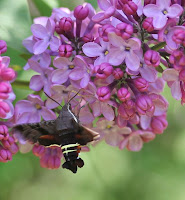
Hummingbird clearwing moth!
One of the diurnal moths
Leggo!!!!

Xylophanes tersa Tersa Sphinx
A great, long proboscis
Blinded sphinx underwing

Paonias excaecata
Blinded sphinx


Bipectinate antenna;
fuzzy wuzzy basal area!

Clearwing in spring on lilac

Friday, 26 July 2013

Sphinx on phlox, not in sox

I find it hard to let go and worry that I have not done something today. But, then, getting up and out in the dawn has led to some amazing sights. Two days ago it was something that looked like a long, black mink or weasel. Buster was busy defending his property against a calico cat that appeared on our back deck. You know that cat howl in the dark!
I'm glad he didn't go after it, whatever it was.
White-lined sphinx on phlox

You take the opportunities.
I do adore getting up in the night, having had a date with Mr. Insomnia, and going outside to take a photo in the dark. I now see insomnia as an opportunity, rather than a burden. I have no alarm clock that controls my life. I can be sick and read or watch TV all day, should I wish. Theoretically, guilt-free.

They couldn't fathom Buster, in the dark,
on the cement steps rolling around,
while they were kept indoors.
I slept in until 9:30 this morning. Very strange. Hubby tiptoed about in the kitchen. I've just begun processing my photos of last night's shoot. With the cold and dark, the mosquitoes were few and far between, and the deerflies prefer the hot sun. The daytime dragonflies were sleeping.

An elusive moth I've been trying to capture, a large White-lined sphinx, has been appearing in the night. Not really elusive, but too fast for these eyes framed in graduated lenses. They are tricky when trying to see the critter through the view finder. With many clients who have developed glaucoma, I do not complain. Each life passage is an adjustment, mostly to my prescriptions!

This spider was eating dinner on the
living room window.
I've been trying to photograph the sphinx on my phlox. There has to be a poem there! (I'll work on that!)

Sphinx on phlox, not in sox
Slippers sure, cold feet cure
Lens in hand, please please land
Cats they peer, eyes of fear
Mum does what? she's a nut
Cold night quest, much success!

Like the Underwing family, there are colours hidden
when they sit with folded wing

You can see its proboscus

Wee little legs!

They flit, buzz, hover, like hummingbirds. Buster took a whack at one but, thankfully, missed.

White-lined sphinx on phlox


Sphinx moth in the dark from Jennifer Jilks on Vimeo.
A sphinx moth, difficult to photograph, sucking up the nectar. Buster was nearby, rolling on the cool cement steps. Kittens were supportive in the window!
Last year I managed a photo of other sphinx. They are the size of hummers!
Sphinx chersis
Great ash sphinx

Sphinx chersis
Great ash sphinx
Xylophanes tersa Tersa Sphinx

Paonias excaecata
Blinded sphinx