 |
Female Io - Automeris io moths,
are as large as the sphinx! |
The Io moths and Imperial moths are large, but the sphinx tends to be the most diverse.
I've managed to photograph both the Io caterpillar and moth. A tricky job, I can tell you.
 |
| Io caterpillar |
Half the battle in IDing them is knowing your ecosystem, habitat range, and the likely species you might find.
 |
Io moth with closed wings,
fabulous eyes on the underwing |
The largest I've photographed was the Imperial moth. It was resting one summer morning last year, on our cedar rail fence right beside the house. More common are the sphingidae or sphinx moths.
Feeding at night
 |
| Large, Imperial moth |
 |
| Io eating my Hops plant leaves! |
They feed on tubular flowers, like my phlox, with their long proboscis.
Most, the Peterson Field Guide says, are nocturnal and are drawn to the lights.
Two nights ago we managed photos of this friendly sphinx, as well as a baby
gray tree frog and a
firefly.
Moth identification
I use the
BAMONA website, staffed by volunteers, experts who help me identify the moths and butterflies. There are so many about.
More than 11,000 moths alone, with my
Peterson Field Guide to Moths of Northeastern North America IDing only 1500. It does help when you understand the difference between a Silk moth, an underwing, and a sphinx!
Trapping Moths
 |
| Lovely markings on the sphinx |
There are ways to trap moths, using sugar as bait is one. They also have fancy dancy traps, with a light in the middle, and a clear funnel to safely trap them. Some people have created their own Skiner traps using a light and egg cartons as a resting substrate. Their gossamer wings are fragile, and any people I know are against harming a creature in order to trap and photograph it.
Moth bait
Some moths understand that lights are fake, and you'll need nectar to attract them.
One mixture consists of:
- a soft banana
- a scoop of brown sugar
- a dollop of molasses,
- a glug or two of beer.
Paint this on a tree, or on a thick rope strung between supports. Watch out for the raccoons, though! Check it regularly.
Photographing moths
 |
Imperial moth body
is the diameter of my finger |
They are tricky to photograph, in the dark. I often spot them while trying to get cats in at night, as they are strong fliers and zoom about like the hummingbird.
They also say to put the moth in the fridge for one night to cool it down, making it slower and easier to photograph in natural daylight. They get into a state of torpor, calms them and lowers their metabolism.
Sphinx moths
 |
| White-lined sphinx on phlox |
Fascinated with critters in the dark, I could see a sphinx thrashing about in the spotlight. They love the phlox and I usually see them when they are in bloom. The larvae of the sphinx pupate in the soil, feeding on wood or herbaceous plants.
This sphinx seemed to quite adore us!
They are quite impressive, as you can see from the photos. The Hummingbird clearwing is the smaller of this species. It is often called a hummingbird moth.
Their bodies, as my field guide says, are 'robust!' They come to a point.
 |
Sphinx are all over the place
|
Narrow wings (e.g., Great ash sphinx), or some, like the Blinded sphinx, have irregular wings, almost like tatted lace. The Blinded sphinx photo below shows the pretty colour in the underwing.
Here are some of the other sphinx moths I have photographed!
 |
Hummingbird clearwing moth!
One of the diurnal moths |
 |
Leggo!!!!
|
 |
| Blinded sphinx underwing |
 |
Bipectinate antenna;
fuzzy wuzzy basal area!
|
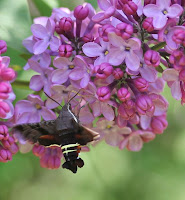 |
| Clearwing in spring on lilac |


