Showing posts with label rain gauges. Show all posts

Thursday, 4 August 2022

Critters, composter, crummy rain

I was so excited. It looked like we were getting rain. I followed it on the radar, and satellite maps.

I was really disappointed. It was a huge storm, with lightning strikes everywhere. I have found that the lightning map gives a good indication of the direction of the storm. 

The North American radar showed the clouds.


The rain predictions were hopeful, but terribly wrong for us! The clouds tend to peter out over the land after picking up moisture from the Great Lakes.

Elora, Ontario, had what looks like a tornado. Some from that way posted a video. Lots of trees were down. There were power outages.


Today, clouds. I don't know if I should water or not!
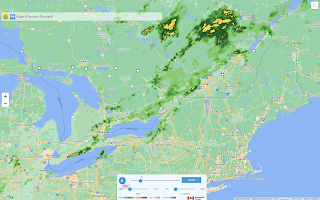
 We didn't even have enough rain to gather in the rain gauge. It all petered out as it moved across the continent.

⚡⚡⚡⚡⚡⚡⚡⚡⚡⚡⚡⚡⚡⚡⚡⚡⚡⚡⚡⚡⚡⚡⚡⚡

Years ago, I found that the bears liked my big, outdoor composter. One year Bear knocked it over 3 times! I finally got Bear wise and gave up. I saw a message on the Perth Barter Board on Sunday. A woman was looking for one for her home in town. I didn't really need anything in exchange. I washed off the outside, threw it in the car, and we took it to her. 

There were turkeys on Ian Millar's field.
Cyclists are enjoying the weather.
And walkers...
Skateboarders

🏀LANARK LIFESTYLES is working on their senior's complex new building. It is coming along.


Farewell, composter! 

Γ†thelred is back! YAM named him back in 2016! Of course, that bear is probably gone. In April, 2020, I posted this in 2020: our Bears are on the move! <= We've had bears over the years.

Bear July 30th from Jennifer Jilks on Vimeo.

  πŸ“· πŸ“· πŸ“· πŸ“· πŸ“· πŸ“· πŸ“· πŸ“· πŸ“· πŸ“· πŸ“· πŸ“· πŸ“· πŸ“· πŸ“· πŸ“· πŸ“· πŸ“· πŸ“· πŸ“· πŸ“·

In my MAC photos app I found something whilst fooling around with photos. On my Apple photo stream, if I open an image, and click on the information icon:, it will show you, according to some algorithm, what your plant might be. I found it accidentally, and forgot about it.


This is the front garden. It is lovely chaos. The hummers love the lilies. The deer love the hosta!
I have photos of good years! Clover seems quite keen on the ones near the house. They haven't been this rigorous in previous years.

I do my best, and I know we moved into deer habitat! What the heck. 

tiger lilies & hosta from Jennifer Jilks on Vimeo.

Sunday, 14 June 2015

New rain gauge!


Unfortunately, it's not metric, but it is a much more efficient and accurate gauge!

I have to interrupt my post for a BULLETIN: 


Wood duck #2 on nest from Jennifer Jilks on Vimeo.
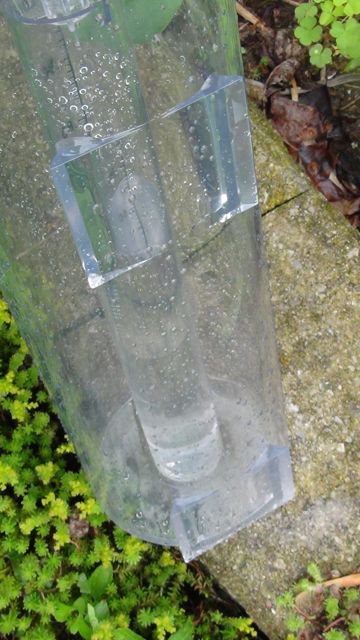
It needs to be attached to a piece of wood, sliding on and off that makes it easier to empty and repost. I saw it at Lee Valley Tools, and ordered it on their 'free P & H" blitz. With all our health issues, I've had to ensure there were things to keep me busy. It's a serious gauge! (I keep telling the kids we are spending the family fortune, so suck it up, buttercups!)

" The Stratus™ is guaranteed accurate to 1/100th of an inch!"

and...

Stratus™ Rain Gauge, a precision weather instrument manufactured to United States Weather Bureau specifications."

I walked down through the meadow, in my flip flops, and it was flooded with all our rain. (We had 52mm = 2" Monday, and then more Tuesday.) Lanark County has very shallow geology, and the lake where I canoe is only 60' deep at its max. There is a lot of pooling of water, until it runs off into the bogs, or the frog pond, where the meadow drains.

Now, I'm not a serious weather person, like hubby (who checks the on-line radars several times a day) I just like math and playing around with the data. However, with all our trips to the city for healthcare appointments (36 so far, #37 in July), we do watch for snow warnings, and how hot or cold or rainy it will be.

The experts debate this one, Stratus, and explain that you can measure snow by weight. I just use a ruler!
I use Dashboard to convert to metric.

There are forums where they talk about greasing the sides of the cup and tubes – mixed notions on that one!

The precision experts say to swing the tubs, centrifuge-style, to ensuring you get the drops from the side of the tube. I must admit I've done this, seems silly for my fun blog!

It took me a couple of days to figure out where to put it. Actually, it arrived last week, when we had our granddaughters, and I just left it until this week to figure out.

This really doesn't work for small amounts.
It's just pretty!
Tuesday: 20 mm (0.79")
same day: 0.65" (16.51mm)

It has an inner tube,
which measure <1" accurately.

Clever brackets which slide
onto the piece on the post.
There it is, on the middle deck.
You can see the dead Cherry Tree.
It's not supposed to be under a tree.
No problem now!

I installed the bracket on a piece of wood,
which I attached to the deck.

Friday, 11 July 2014

Brain games, rain data and the metric system

Truthfully, don't waste your money!
I bought this for when I'm sitting
with a hospice client who sleeps.

You can buy books, or dear computer applications, which give you brain gym-type exercises, or you can create your own fun and games!

I love recording the rain data, but then I loved teaching math, too. Data is fun to collect, and keeps me amused.

I've got 3 gauges, now. Small, medium, and an electronic one. The medium-sized one begins at 0.5 cm (even though we measure rainfall in mm = 5mm), the smaller one begins at 10mm. Someone missed the math lesson! We converted to metric measurement from Imperial when I was at the Faculty of Education (1981). That was fun to master!

This ladder is for area, but it works for all metric metric conversions.

Metric measurement
I made my students memorize this chart, and it was a great little quiz for them. When you move each step on the ladder, you simply move a decimal place. Therefore, 10.0 mm = 1.0 cm. We don't use dm (decimetres or decametres), and we use hm for large farms, etc., but they need their place on the ladder. So to change millimetres to metres: 100.0 mm =  0.100 m, you climb three decimal places up the ladder, with the decimal going three places over.  This requires you to know that there are invisible decimal places for a whole number. As well, you cannot write a naked decimal; we require a 0 in front of the decimal place in our final answer! Nor do we begin a sentence with a number, either. But many journalists failed this lesson, too.


The new gauge is quirky!
Back to my gauges, which are just plain wrong. Blame a designer who missed the math lesson, or a US-based manufacturer.
Thing is, the first two usually agree, but the electronic one is very different. It only registers in inches, and I have to convert it to metric. Even so, it reported 0.45" = 11.43mm. The other two agreed and reported 18mm = 0.7" or rain.

Not only this, but the battery-powered gauge was a twitch to set up. You have to put the batteries in the measurement part, which has a little cup which fills, tips, and registers on the main gauge. Then you put the batteries in the monitor, set it 3 -  5' away, and wait 15 minutes for them to become friends. It took me 4 tries to remember all this and do it all correctly, then it took another 3 days for enough rain to fall for it to think it had a job to do.

The other two gauges managed to collect 1mm of water in the days between, after a quick, but insignificant dump of rain. I think I wasted my money!
Unfortunately, we don't measure rain in cm, as on the gauge.
1.8cm = 18mm = 0.7"


2cm = 0.8"

This collects the water, then flip and dumps it out.
Communicating with the metre on the wall.

It seemed simple enough!
It only reports inches!