Showing posts with label mnr. Show all posts

Friday, 17 January 2014

Ice; fishing safety, common sense rules and regulations

Happy family on Family Day
Ironic seeing people on the ice in winter,
whereas they drove in circles on the water all summer!
It's been a wonky season for those who depend upon snow and ice for winter income, not to mention those who enjoy winter activities. Some of my readers are shocked with the winter weather patterns! The ice is pretty unpredictable in many spots. Heaven forbid we have incidents, such another tragic loss of life. Everyone (OPP and OFSC) was warning us to stay off the ice in December. Now, in January, there are still danger spots. Ice Storm 2013 was a bad sign of Climate Change for all of us.

One of the joys of winter for many is ice fishing. That has been a bit wonky lately, what with Ice Storm 2013! Even our wetland hasn't been frozen, and it's only about 4' deep in spots. There are many cases of people going through weak ice, often near rivers where fast-flowing water precludes ice thick enough for people and machines.

The worst was a family on ATVs, in March, 2009. Traveling on a lake which, in the past, was safe in March. However, they were driving between two islands, where water moves faster, ice is weaker. Losing a precious woman/mother/leader, a mover and shaker in this region, was tragic.

ICE: accidents waiting to happen
Muskoka's Carolyn Bray, and her daughter, have gone through the ice on Lake Rosseau and drowned.
The gray ice is a bad sign of melting ice!
The snowmobile incidents (2012), Sledding at the speed of suicide, can be horrifying for families.
In 2013, OPP put out a press release:
Snow machines - 2013 Canadian incidents
Ontario Provincial Police: The OPP is also issuing a timely public warning that 16 people have died in snowmobile incidents so far this year (as of March 25, 2013) and seven of those deaths have occurred within the last three weeks. 
At the risk of preaching to the choir, I would hope that someone calls people to be sensible and careful and err on the side of caution. I hope that a good word would cause someone to remember that somebody out there loves you. This is what the OPP and OFSC tell us...

No Ice is Totally Safe: 


  • Check ice thickness and quality before riding onto any frozen water. 
    I love this photo: showing open water where the bubblers lie.
    Fishing huts nearby! 
  • Understand that ice conditions may vary from day to day, from hour to hour and from place to place. 
  • Never travel on ice alone, at night or while impaired. 
  • Avoiding slushy ice, untracked ice, or ice near moving water or dock bubblers. 
  • Watch out for obstacles like rocks, stumps, docks, ice roads and fishing huts. 
  • Wearing a buoyant snowmobile suit and carrying ice picks.


 In many parts of this continent, you must register your hut. This is true in cottage country in many locales, including Ontario. There are also rules and regulations around these huts.

The M.N.R. still requires registration of permanent ice huts in many Fisheries Management Zones, and registration numbers must be clearly displayed on the hut. Permanent ice huts must be removed on or before specified dates. It is an offense under the Public Lands Act to leave any ice hut out after ice break up. Anglers are encouraged to check the provincial fishing regulations summary guide for specific details.

... anglers must register new or previously unregistered ice fishing huts ... of Muskoka and Parry Sound. (The above article shows a sinking hut!)

I love this shot –showing the variety of huts!
Many use snow machines and/or ATVs
to get to a favourite fishing spot.
This one, between two islands,
might be dangerous in March.

First you build a fire, then you dig a hole!
Some were listing, melting in the ice!


Good exercise, hard work!

Thursday, 7 November 2013

It's hunting season in Ontario: 6 injuries!

Deer-hunting season comes with self-inflicted hazards

UPDATE: We're up to 6 injuries in Southeastern Ontario!
It's better than the 'good old days!'  In the 1960s there were more than 100 incidents a year. By the 70s, there were 16 people that died. Now, there is better training. These days, we can expect about 10 incidents per year.

  • All ages get hurt, it seems. A 75-year-old in North Glengarry Township.
  • A 23-year-old in North Grenville.
  • A 59-year-old outside Smiths Falls.

On their way, via boat,
to hunt on Crown Land.
A 22-year-old died last year. This year 6 men have had serious incidents.


Deer hunting season begins.
I've whined about the hunters near-by, since our property abuts one where they target shoot (for hours all day) and hunt sporadically, which isn't so bad. We have 16 acres, they have 35. I'll not go on about it. Sorry! For me, the noise is terrible.

I think it terribly sad that with the season just beginning, there have been 5 shooting incidents. (You cannot call them accidents. I figure it is a self-inflicted wound!) Basic safety says, keep you finger off the trigger, point it away from yourself, keep the safety on until you're ready!

Excellent grounds crew!
 Illegal hunting is the bane of landowners around the province, whether they hunt or not. Hunting violations are reported by the MNR. One neighbour, with 600 acres, finds hunters parking near their land, and off they go in, without permission. I understand the traditions of the 'sport', and further understand that many fill their freezers, especially in the north, whilst culling herds, but stupidity abounds. Disrespect for property and property owners, and pollution, exists on the land, water and in the air.

Man seriously injured in hunting accident in Madoc, Ont.
This incident involved a 59-year-old man on Weedmark road in Montague Township.
"Provincial police say officers were called to the scene in a wooded area north of Madoc on Monday after a man who was with a group of hunters accidentally shot himself."

target practice
The others took place in Tudor and Cashel Township, about 80 kilometers north of Belleville, and in Odessa. There were two who shot themselves in the hand, one on the torso.
Next: a Barrie report:
Since Monday, five people have been accidentally shot while hunting in Ontario – one incident was on Monday near Ottawa, and four people were shot yesterday including a 17-year-old near Peterborough, a man in Huron County and two people in Essa Township.
A North Glengarry man, 75, also sustained a gunshot injury when his shotgun accidentally discharged on Nov. 7. So far police have laid charges in only one of these cases – a teen from Essa has been charged with careless use of a firearm and that gun has been seized by police as part of the investigation.

2013 Hunting Regulations Summary Cover
Hunting Regs.
for 2013/2014
The Ministry of Natural Resources is asking for our help to curb illegal hunting. (Hunting Regs. for 2013/2014Hunters are reminded they have to unload and encase firearms from a half hour after sunset to a half hour before sunrise. It is also illegal to possess a loaded firearm, or shoot a firearm in a vehicle. 

If you know of anyone partaking in any illegal hunting, which also includes hunting without a license, you’re asked to call your local police and report it. 1-888-310-1122 You’re also reminded that your report can be completely anonymous. To contact the Ontario MNR about hunting concerns or illegal hunting practices contact the MNR’s tip line: 1-877-TIPS-MNR (1-877-847-7667).
For hunting rules and regulations, visit mnr.gov.on.ca or ohep.net.
That ends my public service information!

Friday, 11 October 2013

Moose cow harassed in Northern Ontario

Moose photo from my Algonquin photography trip
Two men have been fined after harassing a swimming moose in Northern Ontario back in July. The MNR provides regualar enforcement reports about those who have been convicted of such deplorable actions.
Andrew Weiers of Dryden, Ont., and Matthew Weiers of Fort Saskatchewan, Alta., have been fined a total of $2,500 for harassing a cow.
They were in a boat, doing circles around it, according to several news sources, whilst their friends encouraged them. One of the men got out of his boat and got onto the gentle beasts back.
The two men, pleaded guilty to the offence in the Ontario Court of Justice.

 Apparently, Drew Myers  outdoorsman, writer and resident of Eagle Lake, intervened on behalf of the animal, coming between the partyers and the moose.
We all have to stand up for those who cannot speak for themselves.

Thankfully, the MNR has taken punitive action.
If we had access to their Facebook pages, we'd see how they joke about this.
People continue to hunt illegally...

Fines And Probation For Illegal Moose Hunting. Two hunters have been fined a total of $5,500 and one received two years of probation for illegal moose hunting.
Fines of $5,000 and Suspensions for Illegal Cow Moose Cover Up . Five men belonging to a Bancroft area hunting camp have been charged with 13 offences, fined $5,000
$12,000 In Fines For Wildlife Offences. Five Ontario men received hefty fines totalling $12,000 and hunting suspensions after pleading guilty to various hunting offences.
$7,500 In Illegal Deer Hunting Fines . Two Ontario hunters have been fined a total of $7,500 for offences related to illegal deer hunting. Michael Wendel, of ...

Saturday, 29 December 2012

Men fined $53,000 for damaging snake habitat

Can you imagine?
A hermit thrush who lives on the edge of the wetland.
I spotted it last spring.
Mankind's true moral test, its fundamental test (which lies deeply buried from view), consists of its attitude towards those who are at its mercy: animals. And in this respect mankind has suffered a fundamental debacle, a debacle so fundamental that all others stem from it. 
-Milan Kundera, novelist, playwright, and poet (b.1929) 

I often read the Ontario MNR News Releases. It isn't amusing and it is shocking. People with no respect for a wetland, or the critters that inhabit it.


pond puppy
There are many who violate not only common sense laws of the land, but the specific details. Thing is, the latest report is of these people sentenced in Parry Sound, but they live in south west Ontario. That is a distance of more than 460km (285 m)!

This latest report is of a pair who apply for a work permit in 2010 in spring, to build a trail across Crown Land. They are denied the permit. The reason is that this land contains an endangered species, including the eastern fox snake. They are endangered because they are similar to rattle snakes, and people feel obliged to kill those. The thing is, there aren't just snakes, but many critters the snakes keep in check.

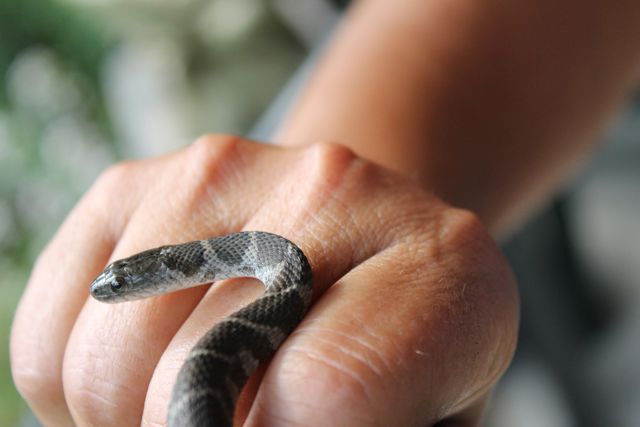
baby watersnake
They go ahead anyway, and on July 8th rent a backhoe and begin. The MNR issues a stop work order July 9th, which they violated. Back they were, July 12th they were reported and caught having done work all weekend. The fines are substantial. How dare they? An enormous lack of understanding of habitat, the importance of ecosystems, and the cycle and the balance of life.

 Paul VanErp, of Bothwell, Ontario, and Kyle VanDeven, of
rattlesnake
Kerwood, Ontario, were convicted and fined a total of $53,000 for offenses under the Endangered Species Act and the Public Lands Act.


From CottageCountry.ca
Justice of the Peace Diane Lafleur heard the case in the Ontario Court of Justice in Parry Sound on October 22, 2012.

The fines for VanErp:

  • $20,000 for damaging endangered species habitat
  • $8,000 for constructing a trail on Crown land without a permit
  • red snake
  • $5,000 for violating a stop work order. 
The fine for VanDeven:
  • $12,000 for damaging endangered species habitat
  • $4,000 for constructing a trail on Crown land
  • $4,000 for violating a stop work order. 

dock spider

Nature will bear the closest inspection. She invites us to lay our eye level with her smallest leaf and take an insect view of its plain. 
-Henry David Thoreau, naturalist and author (1817-1862)


garter snake
To report a natural resources violation call 1-877-TIPS-MNR (847-7667) toll-free any time or contacting your local ministry office during regular business hours. You can also call Crime Stoppers anonymously at 1-800-222-TIPS (8477).

Monday, 20 June 2011

Hunting migratory birds

We think adult siblings cared for their broods together!
Environment Canada lists all of the violations here
This one pissed me off!

Poachers Hit with Large Fines and Hunting Suspensions for Violations under the Migratory Birds Convention Act, 1994

GANDER, NL -- May 9, 2011 -- A two-year investigation by Environment Canada’s Enforcement Branch into the excessive harvest and illegal selling of migratory birds in the Twillingate and New World Island areas of Newfoundland and Labrador has resulted in convictions and heavy fines for local poachers.
Hardy Brian Dove, age 55 of Twillingate, pleaded guilty on April 11, 2011 in Provincial Court in Gander, Newfoundland and Labrador to charges under the Migratory Birds Convention Act, 1994. He was sentenced on May 6, 2011.
Mr. Dove was fined $4,800 for illegally selling murres and eider ducks, and for exceeding the possession limit for these species. He was also fined $1,360 for monetary gain from the sale of migratory birds. Mr. Dove was also ordered to surrender a 5.8 metre boat and motor, one shotgun, a number of duck decoys, and other hunting items to the Crown. He is also prohibited for six years from hunting or being in the company of anyone hunting migratory birds.


U.S. Hunter Charged With Violations While Hunting Waterfowl

It is alleged that Foiles committed violations while hunting and filming in Canada.
The fine = $1 million/offence.
The charges relate to alleged violations of Canadian hunting and criminal laws occurring between 2003 and 2007, including:
  • causing unnecessary pain and suffering to a bird contrary to the Criminal Code;
  • taking over the daily bag limit of geese;
  • taking over the daily bag limit of ducks;
  • continuing to hunt after daily bag limit is reached;
  • hunting from a moving boat or boat under power;
  • failing to immediately retrieve a migratory game bird; and
  • failing, after retrieving a migratory game bird, to immediately kill the bird
  • Under the Migratory Birds Convention Act, 1994, the maximum penalty for indictable offences is $1 million per offence or the possibility of imprisonment for a term of not more than three years, or both.

Wednesday, 16 March 2011

Hunting blue jays?


Environment Canada - Enforcement - Athens Man Receives Fines An Athens, Ontario man was sentenced March 16 in the Ontario Court of Justice in Brockville, Ontario, to a fine of $855. Mr. James Kenneth Rogers pleaded guilty to two charges under the provincial Fish and Wildlife Conservation Act, 1997. As well, on February 25, 2011, in Brockville, Rogers also pleaded guilty and was fined $1,050 for violations under the federal Migratory Birds Convention Act, 1994. In addition to the $1,905 in fine, Rogers is subject to a one-year prohibition against hunting migratory birds.
- for Violations Under The Fish and Wildlife Conservation Act, 1997 and Migratory Birds Convention Act, 1994

Wednesday, 9 March 2011

Asian-carp arrested at border

Have you seen these suckers?
They're crazy. They are voracious and eat all the algae and plankton, starving smaller fish.
This is the 3rd incident since the fall, the paper says. The fish are supposed to be dead when transported, but they are stopping them at the border where the 6,000 fish were found alive. If a truck had an accident, our ecosystem would be doomed, as it is in Illinois.
It is illegal to bring in an invasive species into Ontario. Beware!

'Asian Silver Carp have infested the Illinois River. The fish are migrating up the Mississippi River and can't be stopped. This video is pretty wild.'


Recorded on September 26, 2009 using a Flip Video camcorder.

Invasive Asian Silver Carp jumping in Stump Lake (Grafton, IL). The water was relatively calm with just a few carp jumping now and again until the two guys showed up on their motorboat and spooked all the fish.


Company busted sneaking Asian-carp across border

An American company has been slapped with a $20,000 fine after the latest in a string of live fish busts at the border.

Tuesday, 4 January 2011

Wild turkeys in Ontario


Wild -- or not -- about turkeys


More than a decade after they were reintroduced to the forests of Ontario, experts are still divided on whether the prolific bird is a boon or a menace, Tom Spears wrote...

This is from an Ottawa Citizen article in Monday's paper. I guess it is a blessed relief reading about nature, MNR policy, and our tax dollars at work.

Australia's floods, Chile's earthquake, deaths in airplanes, murder and suicide bombers seem all too common. Success stories are great to read.

Yet, Spears did not represent both viewpoints. Some would say he did not present the truth. In fact, Karen Bellamy, Manager at MNR, tells me this isn't true and that many supported the reintroduction, and the it was the eastern wild turkey that was reintroduced.

Having written about this before, Wild Turkeys


 (about the reintroduction of turkeys into Ontario), I found that our American neighbours sent us a number of turkeys. The hunter's federations were the motivators, but reintroduction of extirpated species, cycle of life, All God's creatures, and all, seemed to be a good thing.


The article in The Citizen seemed a bit off to me. It suggested that the MNR didn't bring the 'right' species, i.e., the originals, a introduced a hybrid, and it has been ruining farmer's fields. I did some more research and found this:
([PDF]Proceedings of the 9th National Wild Turkey Symposium

As this symposium stated:

Ontario stats: 
  • 24,000 in 1999
  • 55,000 in 2004 with a 129% increase in population from an Eastern subspecies.
  • 80,000 in 2010

One section, by Karen Bellamy (Manager, Species at Risk at Ministry of Natural Resources; MNR) reported at the 2005 Wild Turkey Symposium:
  • within Ontario MNR has contributed to the growth of Ontario’s wild turkey population. In total, 4,400 birds.
  • Wild turkey restoration efforts began in 1984, and by 1987 a total of 274 birds were transferred into Ontario from 6 U.S. states. 
  • Active trap and transfer were trapped and released at 275 sites in Ontario between 1984 and March 2004 (Malhiot, 2005)


History of Wild Turkeys in Ontario


The eastern wild turkey (Meleagris gallopavo silvestris) is native to Ontario and was historically common in southern parts of the province. It was extirpated from the province by 1909 due to unregulated hunting and the clearing of forests for agriculture in southern Ontario.

    There is sound scientific basis for protecting the wild turkey and its habitat and for providing a sustainable harvest. Challenging issues will be 
    • social, political, and economic (changes driven by growth and demographic changes in the human population). 
    • Biological challenges, climate change and introduced species, are directly linked to human activity and much less tractable than the issues the wildlife profession faced in the past (Jenkins 2003).
    Primary management concerns were 
    • Weather, food availability, and habitat limitations. 
    • Nutritional value of winter diets is inversely related to snow depth, with ground diets dominated by acorns or corn of highest metabolizable energy. (Perkins)

    Now, the Citizen article says that our current estimates population of 80,000 turkeys arose from the introduction of 400 turkeys. My research told me about 4400 were harvested from 5 subspecies.
    With hunters only permitted to be taking 3 per year, the population has swollen.
    "The Birds of Canada, Canada's authoritative bird encyclopedia, says the turkey was probably gone from Canada by 1902 because of loss of forest habitat."


    And what is the purpose of turkeys, of it is not to balance the cycle of life? If the purpose was only for the hunters, then that is another issue. Here in SE Ontario, I have 7 acres of forest, and lots of the critters. The Citizen article states:
    These non-native, introduced hybrids represent subspecies (especially those from the central and western United States) that naturally occupy open scrubby land. They are a good apicultural choice, but represent lousy, inappropriate and destructive conservation and species management.

    Seeing as we have has 6, 15 and then a group of 28 visiting our feeders, perhaps they are surviving well here in our forest! Don't all poultry scratch the soil? The deer are much worse than the turkeys!
    I sent the Citizen article liink to Karen Bellamy, and her response:

    "Interesting article, but full of inaccuracies and misinformation from my perspective.  The turkeys in Ontario represent one of the greatest wildlife success stories that we will ever see in our lifetime.  This species that was extirpated in the province and in most of North America has been brought back from the brink of extinction and I think that is something that should be celebrated, not criticized.  If we could only be so lucky with many other species at risk.

    Many naturalists do not share the view that the restoration of this native species to the province was a doomed plan or a bad idea.  In fact they were very supportive all along.
    I do understand the complaints from farmers and have spent considerable hours investigating many of these.  While turkeys can do some damage to crops, it is generally minimal and not even in the same league as the crop damage that deer and raccoon can do.
    There has been extensive work done on turkey genetics and the birds in Ontario are not some funny hybrid, but are the real McCoy.    The wild Turkeys that were used to restore the species in ON were pure Eastern Wild Turkeys, the same subspecies that was in the Province historically.   In fact, they likely have the greatest genetic fitness of any wild turkey on the continent, due to very careful planned movements of birds across southern Ontario."

    Research, further reading...
    ([PDF])

    Proceedings of the 9th National Wild Turkey Symposium


    • Allison, R. M. 1976. The history of the wild turkey in Ontario.
    • Canadian Field Naturalist 90:481–485.
    • Malhiot, M. 2005. 2004 Ontario wild turkey status report. Ontario Ministry of Natural Resources, Peterborough, Ontario, Canada.
    • Marshall, I. B., and P. H. Schut. 1999. A national ecological framework for Canada 
    • ecostrat/intro.html . Accessed 11 May 2005.
    • Nguyen, L. P. 2001. Feasibility of transplanting eastern wild turkeys (Meleagris gallopavo silvestris) on the Precambrian Shield in central Ontario. Thesis, Laurentian University, Sudbury, Ontario, Canada.
    • Nguyen, L. P., J. Hamr, and G. H. Parker. 2003. Survival and reproduction of wild turkey hens in central Ontario. Wilson Bulletin 115:131–139.
      Thanksgiving turkey (my original post!)Oct 11, 2009